



Note: Ingredients listed on restricted chemical lists
EC/CAS
111-30-8
Name of the chemical
Glutaral
Concentration
71 - 80
EC/CAS
7732-18-5
Name of the chemical
Water, distilled, conductivity or of similar purity H2O
Concentration
31 - 40
General Information
Version
1.0
Revision date
2021-08-30
Product name
Glutaraldehyde, EM Grade, 70%
CAS No.
111-30-8
1.2.1 Relevant identified uses
Use as laboratory reagent, Manufacture of substances
supplier name
Polysciences
Emergency telephone
1-800-255-3924
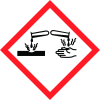
Icons in SDS


Company Information
company name
Polysciences
e-mail address of the competent person responsible for the Safety Data Sheet
info@polysciences.com
GHS Information
Signal word
Danger
Hazard Codes
Hazard statements (CLP)
H290, H314, H317, H318, H320, H334, H335, H400, H411
Hazard statements
Code
Statements
H290
May be corrosive to metals
Section 2
SECTION 2: Hazards identification
Classification of the substance or mixture GHS US classification Corrosive to metals Category 1 May be corrosive to metals Acute toxicity (oral) Category 4 Harmful if swallowed Acute toxicity (dermal) Category 4 Harmful in contact with skin Acute toxicity (inhalation) Category 4 Harmful if inhaled Skin corrosion/irritation Category 1C Causes severe skin burns and eye damage Serious eye damage/eye irritation Category 1 Causes serious eye damage Serious eye damage/eye irritation Category 2B Causes eye irritation Respiratory sensitization, Category 1B May cause allergy or asthma symptoms or breathing difficulties if inhaled Skin sensitization, category 1B May cause an allergic skin reaction Specific target organ toxicity – Single exposure, Category May cause respiratory irritation 3, Respiratory tract irritation Hazardous to the aquatic environment – Acute Hazard Very toxic to aquatic life Category 1 Hazardous to the aquatic environment – Chronic Hazard Toxic to aquatic life with long lasting effects Category 2
2.2 Label elements
GHS US labeling
Signal word
Danger
Hazard statements
May be corrosive to metals Harmful if swallowed, in contact with skin or if inhaled Causes severe skin burns and eye damage May cause an allergic skin reaction Causes serious eye damage Causes eye irritation May cause allergy or asthma symptoms or breathing difficulties if inhaled. May cause respiratory irritation Very toxic to aquatic life Toxic to aquatic life with long lasting effects
Precautionary statements
Keep only in original container. Do not breathe dust/fume/gas/mist/vapors/spray. 02/27/2026 EN (English US) Page 1 Avoid breathing dust/fume/gas/mist/vapors/spray. Wash hands, forearms and face thoroughly after handling. Do not eat, drink or smoke when using this product. Use only outdoors or in a well-ventilated area.
Other hazards which do not result in classification
No additional information available
Ingredient(s) with unknown acute toxicity
Not applicable
2.1 Classification of the substance or mixture
GHS US classification Corrosive to metals Category 1 May be corrosive to metals Acute toxicity (oral) Category 4 Harmful if swallowed Acute toxicity (dermal) Category 4 Harmful in contact with skin Acute toxicity (inhalation) Category 4 Harmful if inhaled Skin corrosion/irritation Category 1C Causes severe skin burns and eye damage Serious eye damage/eye irritation Category 1 Causes serious eye damage Serious eye damage/eye irritation Category 2B Causes eye irritation Respiratory sensitization, Category 1B May cause allergy or asthma symptoms or breathing difficulties if inhaled. Skin sensitization, category 1B May cause an allergic skin reaction Specific target organ toxicity – Single exposure, Category May cause respiratory irritation 3, Respiratory tract irritation Hazardous to the aquatic environment – Acute Hazard Very toxic to aquatic life Category 1 Hazardous to the aquatic environment – Chronic Hazard Toxic to aquatic life with long lasting effects Category 2



