




Note: Ingredients listed on restricted chemical lists
EC/CAS
5470-11-1
Name of the chemical
Hydroxylammoniumchlorid; Hydroxylaminhydrochlorid Bis(hydroxylammonium)sulfat; Hydroxylaminsulfat (2 : 1) (790/2009)
Concentration
N/A
EC/CAS
1310-73-2
Name of the chemical
sodium hydroxide
Concentration
N/A
EC/CAS
226-798-2
Name of the chemical
Hydroxylammoniumchlorid; Hydroxylaminhydrochlorid Bis(hydroxylammonium)sulfat; Hydroxylaminsulfat (2 : 1) (790/2009)
Concentration
N/A
EC/CAS
215-185-5
Name of the chemical
Potassium or sodium hydroxide (20)
Concentration
N/A
General Information
Revision date
2019-06-05
Product name
HT Pico Protein Express Stop Buffer
1.2.1 Relevant identified uses
Laboratory chemicals
1.2.2. Uses advised against
No further relevant information available
Icons in SDS
Company Information
company name
PerkinElmer Inc
GHS Information
Signal word
Danger
Hazard Codes
Hazard statements (CLP)
H200, H302, H314, H317, H318, H351, H373
Hazard statements
Code
Statements
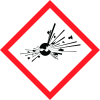
H200
Unstable Explosive
Section 2
CLP CLASSIFICATION
Unst. Expl. H200 Unstable explosives. Acute Tox. 4 H302 Harmful if swallowed. Skin Corr. 1A H314 Causes severe skin burns and eye damage. Eye Dam. 1 H318 Causes serious eye damage. Skin Sens. 1 H317 May cause an allergic skin reaction. Carc. 2 H351 Suspected of causing cancer. STOT RE 2 H373 May cause damage to organs through prolonged or repeated exposure.
Additional information
For the wording of the relevant risk phrases refer to section 16
2.2 Label elements
Labelling according to Regulation (EC) No 1272/2008 The product is classified and labelled according to the CLP regulation.
Hazard pictograms
GHS01 GHS05 GHS07 GHS08
Signal word
Danger
Hazardous Ingredients
hydroxylammonium chloride sodium hydroxide
Hazard statements
H200 Unstable explosives. H302 Harmful if swallowed. H314 Causes severe skin burns and eye damage. H317 May cause an allergic skin reaction. H351 Suspected of causing cancer. H373 May cause damage to organs through prolonged or repeated exposure.
Precautionary statements
P303+P361+P353 IF ON SKIN (or hair): Take off immediately all contaminated clothing. Rinse skin with water/ shower. P305+P351+P338 IF IN EYES: Rinse cautiously with water for several minutes. Remove contact lenses, if present and easy to do. Continue rinsing. P310 Immediately call a POISON CENTER/doctor. P321 Specific treatment (see on this label). P362+P364 Take off contaminated clothing and wash it before reuse. P373 DO NOT fight fire when fire reaches explosives. P380 Evacuate area. P401 Store in accordance with local/regional/national/international regulations. P501 Dispose of contents/container in accordance with local/regional/national/international regulations.
PBT Substances
Not applicable
vPvB Substances
Not applicable


