


Note: Ingredients listed on restricted chemical lists
EC/CAS
611-341-5/55965-84-9
Name of the chemical
Mixture of 5-chloro-2-methyl-2H- isothiazol-3-one (EINECS 247-500-7) and 2-methyl-2H-isothiazol-3-one (EINECS 220-239-6)
Concentration
1.0 - 1.6
General Information
Revision date
2022-01-06
Product name
PARAMO BIOCLEAN
CAS No.
55965-84-9
Emergency telephone
Control Room of PARAMO, a. s.: +420 466 303 175
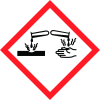
Icons in SDS


Company Information
company name
PARAMO, a.s
e-mail address of the competent person responsible for the Safety Data Sheet
paramo@paramo.cz, ladislava.vichova@paramo.cz
GHS Information
Signal word
Danger
Hazard Codes
Hazard statements (CLP)
H314, H317, H412
Hazard statements
Code
Statements
H314
Causes severe skin burns and eye damage
Section 2
2.1 Classification of the substance or mixture
According to 1272/2008 (CLP) the product is classified as hazardous. Skin Corr. 1B, H314 Skin Sens. 1, H317 Aquatic Chronic 3, H412 2.2 Label elements according to the European Regulation (EC) No 1272/2008
Hazard pictograms
Warning description: Hazard Standard phrases of hazard: Causes severe skin burns and eye damage May cause an allergic skin reaction Harmful to aquatic life with long lasting effects Safe handling instructions Avoid release to the environment Wear protective gloves and eye protection IF ON SKIN (or hair): Remove/Take off immediately all contaminated clothing. Rinse skin with wa- ter/shower. IF IN EYES: Rinse cautiously with water for several minutes. Remove contact lenses, if present and easy to do. Continue rinsing.
Contains
Mixture (3 1) 5-chlor-2-methylisothiazol-3(2H)-on a 2-methylisothiazol-3(2H)-on Other requirements Packaging intended for sale to consumers must bear a tactile warning for blind and have child-resistant fastenings.
2.3 Other hazards
The product is not persistent, bio accumulative and toxic chemical substance or very persistent and very bio accumulative chemical substance according to the criteria set out in Annex XIII to the EC (PBT, vPvB). Causes burns. May cause sensitization by skin contact. Swallowing and subsequent vomiting may make the liquid reach and seriously damage the lungs.



