

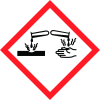


Note: Ingredients listed on restricted chemical lists
EC/CAS
7647-01-0
Name of the chemical
Hydrochloric acid
Concentration
N/A
EC/CAS
7732-18-5
Name of the chemical
Water, distilled, conductivity or of similar purity H2O
Concentration
N/A
General Information
Revision date
2021-01-01
Product name
Weck’s tint etch
Manufacturer Name
PACE Technologies
Icons in SDS


Company Information
company name
PACE Technologies
e-mail address of the competent person responsible for the Safety Data Sheet
pace@metallographic.com
GHS Information
Signal word
Danger
Hazard Codes
Hazard statements (CLP)
H290, H301, H314, H318, H335
Hazard statements
Code
Statements
H290
May be corrosive to metals
Section 2
2.1 Classification of the substance or mixture
Corrosive to metals (Category 1), H290 in accordance with Acute toxicity, Oral (Category 3), H301 29 CFR 1910 Skin corrosion (Category 1B), H314 (OSHA HCS) Serious eye damage (Category 1), H318 Specific target organ toxicity - single exposure (Category 3), Respiratory system, H335
Signal word
Danger
Hazard statements
Hazard Statement(s): H290 - May be corrosive to metals H301- Toxic if swallowed H314- Causes severe skin burns and eye damage H318 - Causes serious eye damage H335- May cause respiratory irritation
Precautionary statements
Precautionary Statement(s):
Prevention
P234- Keep only in original container. P261-Avoid breathing dust/fume/gas/mist/vapors/spray. P264- Wash skin thoroughly after handling. P270- Do not eat, drink or smoke when using this product. P260- Do not breathe dust/fume/gas/mist/vapors/spray. P280- Wear protective gloves/protective clothing/eye protection/face protection. P285- In case of inadequate ventilation wear respiratory protection.
Response
P301+310- IF SWALLOWED: Immediately call a POISON CENTER or doctor/physician. P301+P330+P331- IF SWALLOWED: Rinse mouth. Do NOT induce vomiting. P304+P340- IF INHALED: Remove victim to fresh air and Keep at rest in a position comfortable for breathing. P305+P351+P338- IF IN EYES: Rinse cautiously with water for several minutes. Remove contact lenses, if present and easy to do. Continue rinsing. P310- Immediately call a POISON CENTER or doctor/physician. P321- Specific treatment (see Section 4 SDS). P305+P351+P338- IF IN EYES: Rinse cautiously with water for several minutes. Remove contact lenses, if present and easy to do. Continue rinsing. P390- Absorb spillage to prevent material damage.
Storage
P403+P233- Store in a well-ventilated place. Keep container tightly closed. P405- Store locked up. P406- Store in corrosive resistant container with a resistant inner liner.
Disposal
P501- Dispose of contents/container to Federal, State and Local Regulations. Emergency Overview -------------------------- DANGER! MAY BE FATAL IF SWALLOWED OR INHALED. AFFECTS RESPIRATORY SYSTEM, HEART, SKELETON, CIRCULATORY SYSTEM, CENTRAL NERVOUS SYSTEM AND KIDNEYS. CAUSES IRRITATION AND BURNS TO SKIN, EYES AND RESPIRATORY TRACT. IRRITATION AND BURN EFFECTS MAY BE DELAYED. HARMFUL IF ABSORBED THROUGH SKIN. -----------------------------------------------------------------------------------------------------------
Potential health effects
If inhaled or swallowed, this compound can cause fluoride poisoning. Early symptoms include nausea, vomiting, diarrhea, and weakness. Later effects include central nervous system effects, cardiovascular effects and death. Inhalation: May cause irritation and burns to the respiratory tract, symptoms may include coughing, sore throat, and labored breathing. May be absorbed through inhalation of dust; symptoms may parallel those from ingestion exposure. Irritation and burning effects may not appear immediately. Ingestion: May cause salivation, nausea, vomiting, diarrhea, and abdominal pain, followed by symptoms of weakness, tremors, shallow respiration, carpopedal spasm, convulsions, and coma. May cause brain and kidney damage. Affects heart and circulatory system. Death may be caused by respiratory paralysis. Lethal dose estimated at between 1 teaspoonful and 1 oz. Skin Contact: Causes irritation and burns to the skin. Effects may not appear immediately. Eye Contact: Causes irritation. May be extremely irritating with possible burns to eye tissue and permanent eye damage may result. Chronic Exposure: Chronic exposure may cause mottling of teeth and bone damage (osteosclerosis) and fluorosis. Symptoms of fluorisis include brittle bones,weight loss, anemia, calcified ligaments, general ill health and joint stiffness. Aggravation of Pre-existing Conditions: Populations that appear to be at increased risk from the effects of fluoride are individuals that suffer from diabetes insipidus or some forms of renal impairment.



