

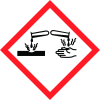

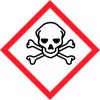
Note: Ingredients listed on restricted chemical lists
EC/CAS
7647-01-0
Name of the chemical
Hydrochloric acid
Concentration
10-20%
EC/CAS
7732-18-5
Name of the chemical
Water, distilled, conductivity or of similar purity H2O
Concentration
70-85%
General Information
Revision date
2023-06-01
Product name
Marble’s Reagent
Chemical name
Corrosive liquid, acidic, inorganic, n.o.s. (hydrochloric acid, cupric sulfate mixture)
Manufacturer Name
PACE Technologies
Emergency telephone
800-424-9300
Icons in SDS


Company Information
company name
PACE Technologies
e-mail address of the competent person responsible for the Safety Data Sheet
pace@metallographic.com
GHS Information
Signal word
Danger
Hazard Codes
Hazard statements (CLP)
H290, H301, H314, H318, H335, H400, H410
Hazard statements
Code
Statements
H290
May be corrosive to metals
Section 2
SECTION 2: Hazards identification
Signal word
Danger
Hazard statements
Hazard Statement(s): H290 - May be corrosive to metals H301- Toxic if swallowed H314- Causes severe skin burns and eye damage H318 - Causes serious eye damage H335- May cause respiratory irritation H400- Very toxic to aquatic life H410- Very toxic to aquatic life with long lasting effects
Precautionary statements
Precautionary Statement(s)
Prevention
P234- Keep only in original container. P260- Do not breathe dust/fume/gas/mist/vapors/spray. P261-Avoid breathing dust/fume/gas/mist/vapors/spray. P264- Wash skin thoroughly after handling. P270- Do not eat, drink or smoke when using this product. P271-Use only outdoors or in a well-ventilated area. P273- Avoid release to the environment. P280- Wear protective gloves/protective clothing/eye protection/face protection.
Response
P301+310- IF SWALLOWED: Immediately call a POISON CENTER or doctor/physician. P301+P330+P331- IF SWALLOWED: Rinse mouth. Do NOT induce vomiting. P304+P340-IF INHALED: Remove victim to fresh air and Keep at rest in a position comfortable for breathing. P305+P351+P338- IF IN EYES: Rinse cautiously with water for several minutes. Remove contact lenses, if present and easy to do. Continue rinsing. P310- Immediately call a POISON CENTER or doctor/physician. P312-Call a POISON CENTER or doctor/physician if you feel unwell. P321- Specific treatment (see Section 4 SDS). P330- Rinse mouth. P390- Absorb spillage to prevent material damage. P391- Collect spillage. Hazardous to the aquatic environment
Storage
P403+P233- Store in a well-ventilated place. Keep container tightly closed. P404- Store in a closed container. P405- Store locked up. Color Code White (Corrosive)
Disposal
P501- Dispose of contents/container to Federal, State and Local Regulations. Emergency Overview POISON! DANGER! CORROSIVE. LIQUID AND MIST CAUSE SEVERE BURNS TO ALL BODY TISSUE. MAY BE FATAL IF SWALLOWED OR INHALED Health Rating 3 - Severe (Poison) Flammability Rating 0 - None Reactivity Rating: 2 - Moderate Contact Rating 4 - Extreme (Corrosive) Lab Protective Equip GOGGLES & SHIELD; LAB COAT & APRON; VENT HOOD; PROPER GLOVES
Potential health effects
Inhalation: Corrosive! Inhalation of vapors can cause coughing, choking, inflammation of the nose, throat, and upper respiratory tract, and in severe cases, pulmonary edema, circulatory failure, and death. Ingestion Corrosive! Swallowing hydrochloric acid can cause immediate pain and burns of the mouth, throat, esophagus and gastrointestinal tract. May cause nausea, vomiting, and diarrhea, and in severe cases, death. Skin Contact Corrosive! Can cause redness, pain, and severe skin burns. Concentrated solutions cause deep ulcers and discolor skin. Eye Contact: Corrosive! Vapors are irritating and may cause damage to the eyes. Contact may cause severe burns and permanent eye damage. Chronic Exposure Long-term exposure to concentrated acid vapors may cause erosion of teeth. Long term exposures seldom occur due to the corrosive properties of the acid. Prolonged or repeated skin exposure to copper sulfate may cause dermatitis. Prolonged or repeated exposure to dusts of copper salts may cause discoloration of the skin or hair, blood and liver damage, ulceration and perforation of the nasal septum, runny nose, metallic taste, and atrophic changes and irritation of the mucous membranes. Aggravation of Pre-existing Conditions Persons with pre-existing skin disorders, impaired liver, kidney, or pulmonary function, glucose 6-phosphate-dehydrogenase deficiency, or pre-existing Wilson's disease may be more susceptible to the effects of this material. Also persons with pre-existing skin disorders or eye disease may be more susceptible to the effects of this substance.
2.1 Classification of the substance or mixture
Corrosive to metals (Category 1), H290 in accordance with Acute toxicity, Oral (Category 3), H301 29 CFR 1910 Skin corrosion (Category 1B), H314 (OSHA HCS) Serious eye damage (Category 1), H318 Specific target organ toxicity - single exposure (Category 3), Respiratory system, H335 Acute aquatic toxicity (Category 1), H400 Chronic aquatic toxicity (Category 1), H410 PICTOGRAM(s): SIGNAL WORD: Danger HAZARD Hazard Statement(s): STATEMENTS: H290 - May be corrosive to metals H301- Toxic if swallowed H314- Causes severe skin burns and eye damage H318 - Causes serious eye damage H335- May cause respiratory irritation H400- Very toxic to aquatic life H410- Very toxic to aquatic life with long lasting effects PRECAUTIONARY



