

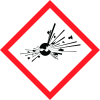
Note: Ingredients listed on restricted chemical lists
EC/CAS
78-11-5
Name of the chemical
Pentaerithrityl tetranitrate (INN)
Concentration
N/A
EC/CAS
13424-46-9
Name of the chemical
Bleiazid
Concentration
N/A
EC/CAS
201-084-3
Name of the chemical
Pentaerithrityl tetranitrate (INN)
Concentration
N/A
EC/CAS
236-542-1
Name of the chemical
Bleiazid
Concentration
N/A
General Information
Revision date
2013-04-26
Product name
eDev
1.2.2. Uses advised against
Usage of the product only according to existing laws and official permissions Function(s) of substance / Detonators for the initiation of capsule-sensitive explosive agents and detonating- mixture cords
supplier name
Orica Finland Oy
Emergency telephone
For medical advice call: +358 9 471 977
Icons in SDS
Company Information
company name
Orica Finland Oy
e-mail address of the competent person responsible for the Safety Data Sheet
finland@orica.com, sds.emea@orica.com
GHS Information
Signal word
Danger
Hazard Codes
Hazard statements (CLP)
H201, H204
Hazard statements
Code
Statements
H201
Explosive; mass explosion hazard
Section 2
SECTION 2: Hazards identification
67/548/EEC Unpackaged detonators are defined as: H201 - Explosive, mass explosion hazard. Risk of explosion by shock, friction, fire or other sources of ignition. Shrapnel from detonation may cause burns and wounds.
2.1 Classification of the substance or mixture
The mixture is classified as dangerous within the meaning of Regulation (EC) No 1272/2008. The preparation is classified as dangerous according to Directive 1999/45/EC. Classification in accordance with Regulation (EC) No. 1272/2008
Hazard categories
category
Hazard statements
Classification method H201 Explosive, mass explosion hazard. H204 - Fire or projection hazard.) Use of special provisions according to 1272/2008/EC art. 23e. Labelling in accordance with Directive 67/548/EEC or Directive 1999/45/EC Hazard symbol(s) Identification of danger Explosive
Additional information
Expl. 1.1 H201 UN RTDG CLP - figure 2.1.3 This classification describes UNPACKED detonators. The transport classification can differ depending on the approved packaging. Wording of Hazard statements (H, EUH): see section 16. Classification in accordance with Directive 67/548/EEC or Directive 1999/45/EC Properties or classification (EU) - - Note By using special approved packaging a reduction of a explosive hazard is possible Specific concentration limits Not applicable
R-phrase(s)
letter E R2 Risk of explosion by shock, friction, fire or other sources of ignition. No additional information R2 Risk of explosion by shock, friction, fire or other sources of ignition.
2.2 Label elements
Labelling in accordance with Regulation (EC) No. 1272/2008
Product definition
eDev™ Index or C&L number Not applicable Hazardous component(s) P.E.T.N., Index No.: 603-035-00-5 Lead diazide, Index No.: 082-003-00-7 Authorization number Not applicable
Signal word
Danger Warning;
Precautionary statements
P210 Keep away from heat / sparks / open flames / hot surfaces. - No smoking. P250 Do not subject to grinding / shock / … / friction. P280 Wear protective gloves / protective clothing / eye protection / face protection. P370+P380 In case of fire: Evacuate area. P372 Explosion risk in case of fire. P373 DO NOT fight fire when fire reaches explosives.
S-phrase(s)
S15 Keep away from heat. S16 Keep away from sources of ignition - No smoking. S20/21 When using do not eat, drink or smoke. S33 Take precautionary measures against static discharges. S36/37/39 Wear suitable protective clothing, gloves and eye / face protection. Note Use of special provisions according to 67/548/EEC art. 25(1) and 1999/45/EC art. 12(1).
Results of PBT and vPvB assessment
No assessment established up to now.
Other hazards
Stythe is heavier than air and may accumulate below ground level, in pits, channels and basements in higher concentration. During use of article, a release of lead containing reaction products occurs. All chemicals are potentially dangerous; they should only be handled by properly trained personnel with the necessary care. The yellow insulation of the lead wire contain the following substance of very high concern: - Lead sulfochromate yellow (C.I. Pigment Yellow 34); 0.9 %(w/w); CAS No 1344-37-2, EC No 215-693-7


