


Note: Ingredients listed on restricted chemical lists
General Information
Revision date
2020-09-01
Product name
ATTACK
Substance name
ATTACK
1.2.1 Relevant identified uses
of A broad spectrum insecticide for use on avocados, citrus, flowers and the chemical and ornamentals, glasshouse tomoatoes and curcurbits, grapes, kiwifruit,
1.2.2. Uses advised against
persimmons, vegetable and fodder brassicas and fodder beet Other Information This SDS describes, to the best of our knowledge, the properties of the concentrated product. The physical properties and some of the assessments do not apply to the properties of the product once it has been diluted for
Icons in SDS


Company Information
company name
Nufarm NZ
e-mail address of the competent person responsible for the Safety Data Sheet
nzinfo@nufarm.com
GHS Information
Signal word
DANGER
Hazard Codes
Hazard statements (CLP)
H227, H303, H313, H315, H317, H320, H333, H334, H361, H372, H410, H423, H431, H441
Hazard statements
Code
Statements
H227
Combustible liquid
Section 2
SECTION 2: Hazards identification
GHS Classification GHS classification of the substance/mixture Classified as Dangerous Goods for transport according to the New Zealand Standard NZS 5433:2012 Transport of Dangerous Goods on Land
Signal word
DANGER
Hazard statements
H227 Combustible liquid. H303 May be harmful if swallowed. H313 May be harmful in contact with skin. H315 Causes skin irritation. H317 May cause an allergic skin reaction. H320 Causes eye irritation. H333 May be harmful if inhaled. H334 May cause allergy or asthma symptoms or breathing difficulties if inhaled. H361 Suspected of damaging fertility or the unborn child . H372 Causes damage to organs nervous system through prolonged or repeated exposure . H410 Very toxic to aquatic life with long lasting effects. H423 Harmful to the soil environment. H431 Very toxic to terrestrial vertebrates. H441 Very toxic to terrestrial invertebrates.
Precautionary statements
P101 If medical advice is needed, have product container or label at hand. P102 Keep out of reach of children. P103 Read label before use. P201 Obtain special instructions before use. P202 Do not handle until all safety precautions have been read and understood.
Hazard pictograms
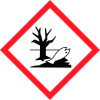
Health hazard,Environment
Prevention
P210 Keep away from heat/sparks/open flames/hot surfaces. – No smoking. P260 Do not breathe dust/fume/gas/mist/vapours/spray. P261 Avoid breathing dust/fume/gas/mist/vapours/spray. P264 Wash contaminated skin thoroughly after handling. P270 Do not eat, drink or smoke when using this product. P272 Contaminated work clothing should not be allowed out of the workplace. P280 Wear protective gloves/protective clothing/eye protection/face protection. P281 Use personal protective equipment as required. P285 In case of inadequate ventilation wear respiratory protection.
Response
P302+P352 IF ON SKIN: Wash with plenty of soap and water. P332+P313 If skin irritation occurs: Get medical advice/attention. P304+P312 IF INHALED: Call a POISON CENTER or doctor/physician if you feel unwell. P342+P311 If experiencing respiratory symptoms: Call a POISON CENTER or doctor/physician. P305+P351+P338 IF IN EYES: Rinse cautiously with water for several minutes. Remove contact lenses, if present and easy to do. Continue rinsing. P337+P313 If eye irritation persists: Get medical advice/attention. P308+P313 IF exposed or concerned: Get medical advice/attention. P362 Take off contaminated clothing and wash before reuse. P370+P378 In case of fire: Use water fog, foam, carbon dioxide or dry chemical for extinction. P391 Collect spillage.
Storage
P403+P235 Store in a well-ventilated place. Keep cool. Precautionary P501 In the case of a substance that is in compliance with a HSNO approval
Disposal
other than a Part 6A (Group Standards) approval, a label must provide a description of one or more appropriate and achievable methods for the disposal of a substance in accordance with the Hazardous Substances (Disposal) Regulations 2001. This may also include any method of disposal that must be avoided. See Section 13 for disposal details.
Further information
3.1D flammable liquid, 6.1E acute toxicant, 6.3A skin irritant, 6.4A eye irritant, 6.5A sensitiser, 6.5B sensitiser, 6.8B reproductive or developmental toxicant, 6.9A target organ toxicant, 9.1A aquatic toxicant, 9.2D soil toxicant, 9.3A terrestrial vertebrate toxicant, 9.4A terrestrial invertebrate toxicant,
2.1 Classification of the substance or mixture
the Standard NZS 5433:2012 Transport of Dangerous Goods on Land. substance/mixture Signal Word (s) DANGER Hazard Statement (s) H227 Combustible liquid. H303 May be harmful if swallowed. H313 May be harmful in contact with skin. H315 Causes skin irritation. H317 May cause an allergic skin reaction. H320 Causes eye irritation. H333 May be harmful if inhaled. H334 May cause allergy or asthma symptoms or breathing difficulties if inhaled. H361 Suspected of damaging fertility or the unborn child . H372 Causes damage to organs nervous system through prolonged or repeated exposure . H410 Very toxic to aquatic life with long lasting effects. H423 Harmful to the soil environment. H431 Very toxic to terrestrial vertebrates. H441 Very toxic to terrestrial invertebrates. Precautionary P101 If medical advice is needed, have product container or label at hand. statement – General P102 Keep out of reach of children. P103 Read label before use. Pictogram (s) Health hazard,Environment Precautionary P201 Obtain special instructions before use. statement – P202 Do not handle until all safety precautions have been read and understood. Prevention P210 Keep away from heat/sparks/open flames/hot surfaces. – No smoking. P260 Do not breathe dust/fume/gas/mist/vapours/spray. P261 Avoid breathing dust/fume/gas/mist/vapours/spray. P264 Wash contaminated skin thoroughly after handling. P270 Do not eat, drink or smoke when using this product. P272 Contaminated work clothing should not be allowed out of the workplace. P280 Wear protective gloves/protective clothing/eye protection/face protection. P281 Use personal protective equipment as required. P285 In case of inadequate ventilation wear respiratory protection. Precautionary P302+P352 IF ON SKIN: Wash with plenty of soap and water. statement – Response P332+P313 If skin irritation occurs: Get medical advice/attention. P304+P312 IF INHALED: Call a POISON CENTER or doctor/physician if you feel unwell. P342+P311 If experiencing respiratory symptoms: Call a POISON CENTER or doctor/physician. P305+P351+P338 IF IN EYES: Rinse cautiously with water for several minutes. Remove contact lenses, if present and easy to do. Continue rinsing. P337+P313 If eye irritation persists: Get medical advice/attention. P308+P313 IF exposed or concerned: Get medical advice/attention. P362 Take off contaminated clothing and wash before reuse. P370+P378 In case of fire: Use water fog, foam, carbon dioxide or dry chemical for extinction. P391 Collect spillage. Precautionary P403+P235 Store in a well-ventilated place. Keep cool.



