


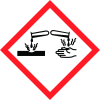
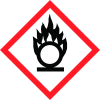
Note: Ingredients listed on restricted chemical lists
EC/CAS
7732-18-5
Name of the chemical
Water, distilled, conductivity or of similar purity H2O
Concentration
60 - 90 %
EC/CAS
7722-84-1
Name of the chemical
Hydrogen peroxide
Concentration
25 %
General Information
Version
1.1
Revision date
2018-10-16
Product name
PROXITANE SANITISER
1.2.1 Relevant identified uses
Cleaning agent - Disinfectants and general biocidal products - Oxidizing agents
supplier name
Clark Products
Icons in SDS


Company Information
company name
No
e-mail address of the competent person responsible for the Safety Data Sheet
orders@clarkproducts.co.nz
GHS Information
Signal word
Danger
Hazard Codes
Hazard statements (CLP)
H272, H302, H312, H314, H332
Hazard statements
Code
Statements
H272
May intensify fire; oxidiser
Section 2
SECTION 2: Hazards identification
This material is hazardous according to criteria of EPA New Zealand. EPA Group Standard: HSR002530 - Cleaning Products (Subsidiary Hazard) Group Standard
Signal word
Danger Hazard Classifications 5.1.1B - Oxidising substances that are liquids or solids 6.1D - Substances that are acutely toxic - Oral 6.1D - Substances that are acutely toxic - Dermal 6.1D - Substances that are acutely toxic - Inhalation - vapours, dusts or mists 8.2A - Substances that are corrosive to dermal tissue 6.4A - Substances that are irritating to the eye Hazard Statements H272 May intensify fire; oxidizer H302 Harmful if swallowed H312 Harmful in contact with skin H314 Causes severe skin burns and eye damage H332 Harmful if inhaled Prevention Precautionary Statements P102 Keep out of reach of children P103 Read label before use P210 Keep away from heat/sparks/open flames/hot surfaces. No smoking P220 Keep/Store away from clothing/combustible materials/(insert appropriate material) P221 Take any precaution to avoid mixing with combustibles/(insert incompatible materials) P260 Do not breathe dust, fume, gas, mist, vapours or spray P261 Avoid breathing dust, fume, gas, mist, vapours or spray P264 Wash hands, face and all exposed skin thoroughly after handling P270 Do not eat, drink or smoke when using this product P271 Use only outdoors or in a well-ventilated area P280 Wear protective clothing, gloves, eye/face protection and suitable respirator Response Precautionary Statements P101 If medical advice is needed, have product container or label at hand P301+P310 IF SWALLOWED: Immediately call a POISON CENTRE or doctor/physician P301+P330+P331 IF SWALLOWED: Rinse mouth. Do NOT induce vomiting P302+P352 IF ON SKIN: Wash with plenty of soap and water P303+P361+P353 IF ON SKIN (or hair): Remove/Take off immediately all contaminated clothing. Rinse skin with water/shower P304+P340 IF INHALED: Remove victim to fresh air and keep at rest in a position comfortable for breathing P305+P351+P338 IF IN EYES: Rinse cautiously with water for several minutes. Remove contact lenses, if present and easy to do. Continue rinsing P310 Immediately call a POISON CENTRE or doctor/physician P312 Call a POISON CENTRE or doctor/physician if you feel unwell P321 Specific treatment (see product label) P322 Specific measures (see product label) P330 Rinse mouth P337+P313 If eye irritation persists: Get medical advice/attention P363 Wash contaminated clothing before reuse P370+P378 In case of fire: Use (insert appropriate media) for extinction Storage Precautionary Statement P405 Store locked up
Precautionary statements
P501 Dispose of contents/container in accordance with local, regional, national and international regulations.
Classifications
Classified as Dangerous Goods by the criteria of the "Australian Code for the Transport of Dangerous Goods by Road & Rail" and the "New Zealand NZS5433: Transport of Dangerous Goods on Land". Dangerous Goods Class: 5.1 Subrisk 1: 8
2.1 Classification of the substance or mixture
5.1.1B - Oxidising substances that are liquids or solids 6.1D - Substances that are acutely toxic - Oral 6.1D - Substances that are acutely toxic - Dermal 6.1D - Substances that are acutely toxic - Inhalation - vapours, dusts or mists 8.2A - Substances that are corrosive to dermal tissue 6.4A - Substances that are irritating to the eye Hazard Statements H272 May intensify fire; oxidizer. H302 Harmful if swallowed. H312 Harmful in contact with skin. H314 Causes severe skin burns and eye damage. H332 Harmful if inhaled.



