

Note: Ingredients listed on restricted chemical lists
EC/CAS
15245-44-0
Name of the chemical
Blei-2,4,6-trinitroresorcinat
Concentration
N/A
EC/CAS
13424-46-9
Name of the chemical
Bleiazid
Concentration
N/A
EC/CAS
1314-41-6
Name of the chemical
Orange lead (lead tetroxide)
Concentration
N/A
EC/CAS
7722-64-7
Name of the chemical
Kaliumpermanganat (2018/1480)
Concentration
N/A
EC/CAS
78-11-5
Name of the chemical
Pentaerithrityl tetranitrate (INN)
Concentration
N/A
EC/CAS
239-290-0
Name of the chemical
Blei-2,4,6-trinitroresorcinat
Concentration
N/A
EC/CAS
236-542-1
Name of the chemical
Bleiazid
Concentration
N/A
EC/CAS
215-235-6
Name of the chemical
Orange lead
Concentration
N/A
EC/CAS
231-760-3
Name of the chemical
Kaliumpermanganat (2018/1480)
Concentration
N/A
EC/CAS
201-084-3
Name of the chemical
Pentaerithrityl tetranitrate (INN)
Concentration
N/A
General Information
Revision date
2018-10-24
Product name
PLAIN DETONATOR FOR NON-ELECTRIC DETONATORS
Manufacturer Name
43-150 Bieruń
Emergency telephone
NITROERG S.A
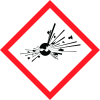
Icons in SDS
Company Information
company name
NITROERG S.A
e-mail address of the competent person responsible for the Safety Data Sheet
sds@nitroerg.pl
GHS Information
Signal word
Danger
Hazard Codes
Hazard statements (CLP)
H201
Hazard statements
Code
Statements
H201
Explosive; mass explosion hazard
Section 2
SECTION 2: Hazards identification
2.1 Classification of the article Expl. 1.1, H201 Explosive, subclass 1.1 All harmful components of the product are enclosed in a metal shell. Full meaning of H- and P-phrases in sections 2 -15: see SECTION 16.
Signal word
DANGER H-phrase(s): H201 Explosive; mass explosion hazard. P-phrase(s): P210 Keep away from heat, hot surfaces, sparks, open flames and other ignition sources. No smoking. P250 Do not subject to grinding/shock/friction. P280 Wear protective gloves/protective clothing/eye protection/face protection. P370+P372+P380+P373 In case of fire: Explosion risk. Evacuate area. DO NOT fight fire when fire reaches explosives. P234 Keep only in original packaging.
2.3 Other hazards
During detonation, highly toxic nitrogen oxides are released. Fire can occur as a secondary effect of a detonation of the product.


