

Note: Ingredients listed on restricted chemical lists
EC/CAS
78-11-5
Name of the chemical
Pentaerithrityl tetranitrate (INN)
Concentration
N/A
EC/CAS
201-084-3
Name of the chemical
Pentaerithrityl tetranitrate (INN)
Concentration
N/A
General Information
Revision date
2015-01-06
Product name
CORDTEX 6N, CORDTEX 10N, CORDTEX 12N, CORDTEX 20N, CORDTEX
CAS No.
78-11-5
1.2.1 Relevant identified uses
PETN detonating cord, rock is destined for use in underground non – coal
Manufacturer Name
NITROERG S.A
Emergency telephone
+ 48 32-46-62-000 (available 6 am until 3 pm, from Monday to Friday
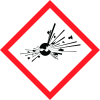
Icons in SDS
Company Information
company name
NITROERG S.A
e-mail address of the competent person responsible for the Safety Data Sheet
nitroerg@nitroerg.pl, sds@nitroerg.pl
GHS Information
Signal word
Danger
Hazard Codes
Hazard statements (CLP)
H201
Hazard statements
Code
Statements
H201
Explosive; mass explosion hazard
Section 2
SECTION 2: Hazards identification
Detonating cords are not the subject of the law on chemical products and preparations. Specific legal regulations are in place to ensure the control of all issues relating to the trade, classification and marking of detonating cords . The product, if misused or subject of forbidden manipulations, may pose explosion risk resulting in heavy bodily injury or even death. 2.1 Explosion Risk Expl. 1.1, H201 There is risk of explosion due to impact, friction or influence of fire and other energy factors. Decomposition of the explosive is occurring in the temperature above 140 °C. During the heating and the combustion toxic gases are emitted: nitrogen monoxides, carbon monoxides and hydrogen chloride.
Precautionary statements
P210 - Keep away from heat/sparks/open flames /hot surfaces. No smoking. P250 - Do not subject to grinding/shock/…/friction. P270 - Do not eat, drink or smoke when using this product. P312 - Call a POISON CENTER or doctor/physician if you feel unwell P372 - Explosion risk in case of fire. P373 - DO NOT fight fire when reaches explosives. P370 + P380 - In case of fire. Evacuate the area. P405 - Store locked up. 2.3 Fire hazard The burning of small quantities take place safely on open space. Combustion of small amounts of the cord in closed spaces or combustion of large amounts of the cord cause move into detonation. The fire is able to arise as the secondary effect of the explosion also. 2.4 Toxicological hazard The detonating cord used in accordance to the destination and instruction for use is causing no consequences and it does not contain toxic components. Toxicological hazard may be caused by direct contact with PETN, included in detonating cord. Paths of absorption: skin, mucous membranes, respiratory system and digestive system. 2.5 Ecotoxicological hazard The product itself and all components of it are insoluble in water, so there is no contamination risk for soils.


