

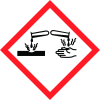
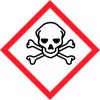


Note: Ingredients listed on restricted chemical lists
EC/CAS
200-001-8/50-00-0
Name of the chemical
Formaldehyde
Concentration
≥25% ≥5-<25.0 ≥5-<25.0
General Information
Revision date
2012-08-17
Product name
Formalin
Product Synonyms
Formalin /37% solution of formaldehyde/
CAS No.
50-00-0
1.2.1 Relevant identified uses
- monomer
Manufacturer Name
NEOCHIM PLC
Icons in SDS


Company Information
company name
NEOCHIM PLC
e-mail address of the competent person responsible for the Safety Data Sheet
neochim@neochim.bg, pto@neochim.bg
GHS Information
Signal word
Danger
Hazard Codes
Hazard statements (CLP)
H301, H311, H314, H317, H331, H351
Hazard statements
Code
Statements
H301
Toxic if swallowed
Section 2
Other physicochemical hazards
Highly volatile liquid. Easily release gas (formaldehyde), which can cause explosion and fire when mix with air and has lower explosion limit of 7% v/v and upper explosion limit of 73% v/v. Potential effects on health Toxic product. The risk depends on the level and on the duration of exposure. Danger of absorption through the skin. Can cause irreversible damage. Skin contact: Possible skin sensitivity. Eye contact: The vapour causes redness, pain and blurred vision. Splashes may cause irreversible eye damage (blindness). Ingestion: Inflammation of the mucous membranes of the mouth, throat, oesophagus and gastrointestinal tract. Possible irreversible damage. Risk of perforation of the oesophagus and stomach. Inhalation: Possible irreversible damage. Inhalation can cause pulmonary oedema.
CLP CLASSIFICATION
Acute toxicity (oral), hazard category 3 (Acute Tox 3), H301 Acute toxicity (dermal), hazard category 3 (Acute Tox 3), H311 Acute toxicity (Inhalation - vapour), hazard category 3 (Acute Tox 3), H331 Skin corrosion/irritation, hazard category 1B, H314 Skin sensitizer, hazard category 1, H317 Carcinogenicity, hazard category 2 , H351
EU Classification
Directive 1999/45/EC (DPD) T; R:23/24/25 С; R:34 R:43 Carcinogenicity, hazard category 3, R:40
Additional information
For full text of R- phrases and H statements: see section 16
2.2 Label elements
Labelling according to Regulation 1272/2008 (CLP)
Signal word
Danger
Hazard statements
H301 Toxic if swallowed. H311 Toxic in contact with skin. H314 Causes severe skin burns and eye damage. H317 May cause an allergic skin reaction. H331 Toxic if inhaled. H351 Suspected of causing cancer if inhaled. Precautionary P202 Do not handle until all safety precautions have been read and understood. P280 Wear impervious chemical resistant protective gloves, protective clothing, protective goggles and gas filter. P301+P330+ IF SWALLOWED: rinse mouth. Do NOT induce vomiting. Immediately call P331 a POISON CENTER or doctor/physician. P303 + P361 + IF ON SKIN (or hair): Remove/Take off immediately all contaminated P353 clothing. Rinse skin with water/shower. P308 + P313 IF exposed or concerned: Get medical advice/attention. P363 Wash contaminated clothing before reuse. P305 + P351 + IF IN EYES: Rinse cautiously with water for several minutes. Remove P338 contact lenses, if present and easy to do. Continue rinsing. P304 + P340 IF INHALED: Remove to fresh air and keep at rest in a position comfortable for breathing. P405 Store locked up. P271 Use only outdoors or in a well-ventilated area. P410+403 Protect from sunlight. Store in a well-ventilated place. P411 Store at temperatures to 30°C up 50°C. P501 Dispose of contents/container in accordance with national and international regulations.



