


General Information
Version
01
Revision date
2016-12-02
Product name
LEISHMAN’S STAINING SOLUTION
1.2.2. Uses advised against
Industrial. For professional use only
Icons in SDS


Company Information
company name
MOLYCHEM
e-mail address of the competent person responsible for the Safety Data Sheet
info@molychem.net
GHS Information
Signal word
Danger
Hazard Codes
Hazard statements (CLP)
H301, H311, H331, H370
Hazard statements
Code
Statements
H301
Toxic if swallowed
Section 2
SECTION 2: Hazards identification
-DSD Regulation EC 1272/2008 (CLP)] Classification of the substance or mixture
Health hazards
Specific Target Organ Toxicity - Single exposure - Category 1 - Danger (CLP STOT SE 1) H370 Acute toxicity, dermal - Category 3 - Danger (CLP Acute Tox. 3) H311 Acute toxicity, Inhalation - Category 3 - Danger (CLP Acute Tox. 3) H331 Acute toxicity, Oral - Category 3 - Danger (CLP Acute Tox. 3) H301
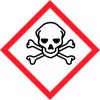
Hazard pictograms
T Toxic
R-phrase(s)
R11 Highly flammable. R23/24/25 Toxic by inhalation, in contact with skin and if swallowed. R39/23/24/25 Toxic danger of very serious irreversible effects through inhalation, in contact with skin and if swallowed.
S-phrase(s)
S4 Keep away from living quarters. S7: Keep container tightly closed. S16 Keep away from source of ignition-No smoking. S24 Avoid contact with skin. S28 After contact with skin, wash immediately with S35 This material and its container must be disposed of in a safe way. S36/37 Wear suitable protective clothing and gloves. S38 In case of insufficient ventilation, wear suitable respiratory equipment. S45 In case of accident or if you feel unwell, seek medical advice immediately ( show the label when possible). S59 Refer to manufacturer/supplier for information on recovery/recycling.
Signal word
Danger
Hazard statements
H301 Toxic if swallowed. H311 Toxic in contact with skin. H331 Toxic if inhaled. H370 Causes damage to organ.
Prevention
P280: Wear protective gloves, protective clothing, eye protection, face protection. P271: Use only outdoors or in a well-ventilated area. P260: Do not breathe dust, fume, gas, mist, vapours, spray. P264: Wash thoroughly after handling. P270: Do not eat, drink or smoke when using this product.
Response
P301+P310: IF SWALLOWED Immediately call a POISON CENTER or doctor. P307+P311: IF EXPOSED Call a POISON CENTER or doctor. P302+P352: IF ON SKIN Wash with plenty of soap and water. P304+P340: IF INHALED Remove to fresh air and keep at rest in a position comfortable for breathing. P363: Wash contaminated clothing before reuse. P361: Remove immediately all contaminated clothing.
Storage
P403+P233: Store in well-ventilated place. Keep container tightly closed. P405: Store locked up. • Disposal considerations P501: Dispose of this material and its container to hazardous or special waste collection point, in accordance with local, regional, national and/or international regulation. P501: Dispose of this material and its container to hazardous or special waste collection point, in accordance with local, regional, national and/or international regulation.
Other hazards
The substance does not fulfil the criteria to be identified as PBT substance or vPvB substance according to Annex XIII of Regulation REACH.
2.1 Classification of the substance or mixture
Classification EC 67/548 or EC 1999/45 Classification : T; R23/24/25-R39/23/24/25 Hazard Class and Category Code(s), Regulation (EC) No 1272/2008 (CLP) Health hazards : Specific Target Organ Toxicity - Single exposure - Category 1 - Danger (CLP : STOT SE 1) H370 Acute toxicity, dermal - Category 3 - Danger (CLP : Acute Tox. 3) H311 Acute toxicity, Inhalation - Category 3 - Danger (CLP : Acute Tox. 3) H331 Acute toxicity, Oral - Category 3 - Danger (CLP : Acute Tox. 3) H301



