

Note: Ingredients listed on restricted chemical lists
EC/CAS
217-123-2/1746-03-8
Name of the chemical
Phosphonic acid, ethenyl
Concentration
<= 100 %
General Information
Revision date
2021-07-01
Product name
Vinylphosphonic acid, 90% for synthesis
CAS No.
1746-03-8
REACH No
is
Emergency telephone
+(44)-870-8200418 (CHEMTREC (GB
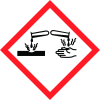
Icons in SDS

Company Information
Company name
Merck KGaA
E-mail address of the competent person responsible for the Safety Data Sheet
TechnicalService@merckgroup.com
GHS Information
Signal word
Danger
Hazard Codes
Hazard statements (CLP)
H290, H314, H318
Hazard statements
Code
Statements
H290
May be corrosive to metals
Section 2
2.1 Classification of the substance or mixture
Classification
2.2 Label elements
Labelling
Signal word
Danger Danger
Hazard statements
H290 May be corrosive to metals. H314 Causes severe skin burns and eye damage. Reduced Labeling (<= 125 ml) H314 Causes severe skin burns and eye damage.
Precautionary statements
P234 Keep only in original packaging. P260 Do not breathe dusts or mists. P280 Wear protective gloves/ protective clothing/ eye protection/ face protection/ hearing protection. P301 + P330 + P331 IF SWALLOWED: Rinse mouth. Do NOT induce vomiting. P303 + P361 + P353 IF ON SKIN (or hair): Take off immediately all contaminated clothing. Rinse skin with water. P305 + P351 + P338 IF IN EYES: Rinse cautiously with water for several minutes. Remove contact lenses, if present and easy to do. Continue rinsing. P260 Do not breathe dusts or mists. P280 Wear protective gloves/ protective clothing/ eye protection/ face protection/ hearing protection. P301 + P330 + P331 IF SWALLOWED: Rinse mouth. Do NOT induce vomiting. P303 + P361 + P353 IF ON SKIN (or hair): Take off immediately all contaminated clothing. Rinse skin with water. P305 + P351 + P338 IF IN EYES: Rinse cautiously with water for several minutes. Remove contact lenses, if present and easy to do. Continue rinsing.
Supplemental label elements
none none
2.3 Other hazards
This substance/mixture contains no components considered to be either persistent, bioaccumulative and toxic (PBT), or very persistent and very bioaccumulative (vPvB) at levels of 0.1% or higher.



