

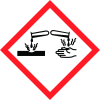
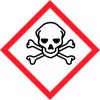


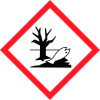
Note: Ingredients listed on restricted chemical lists
EC/CAS
7783-35-9
Name of the chemical
Mercuric sulfate
Concentration
N/A
EC/CAS
7778-50-9
Name of the chemical
Potassium dichromate
Concentration
N/A
General Information
Revision date
2017-11-28
Product name
COD
REACH No
This
1.2.1 Relevant identified uses
Reagent for development and research
Icons in SDS


Company Information
company name
Merck KGaA
e-mail address of the competent person responsible for the Safety Data Sheet
prodsafe@merckgroup.com
GHS Information
Signal word
Danger
Hazard Codes
Hazard statements (CLP)
H290, H302, H302+H332, H311, H314, H332, H340, H350, H360FD, H373, H400, H410
Hazard statements
Code
Statements
H290
May be corrosive to metals
Section 2
2.1 Classification of the substance or mixture
COD
EU Classification
CLASS regulations 2013 Corrosive to metals, Category 1, H290 Acute toxicity, Category 4, Oral, H302 Acute toxicity, Category 4, Inhalation, H332 Acute toxicity, Category 3, Dermal, H311 Skin corrosion, Category 1A, H314 Germ cell mutagenicity, Category 1B, H340 Carcinogenicity, Category 1B, H350 Reproductive toxicity, Category 1B, H360FD Specific target organ toxicity - repeated exposure, Category 2, Kidney, H373 Acute aquatic toxicity, Category 1, H400 Chronic aquatic toxicity, Category 1, H410 For the full text of the H-Statements mentioned in this Section, see Section 16.
2.2 Label elements
Labelling according to CLASS regulations 2013
Signal word
Danger Danger
Hazard statements
H340 May cause genetic defects. H350 May cause cancer. H360FD May damage fertility. May damage the unborn child. H290 May be corrosive to metals. H302 + H332 Harmful if swallowed or if inhaled. COD H311 Toxic in contact with skin. H314 Causes severe skin burns and eye damage. H373 May cause damage to organs (Kidney) through prolonged or repeated exposure. H410 Very toxic to aquatic life with long lasting effects. H340 May cause genetic defects. H350 May cause cancer. H360FD May damage fertility. May damage the unborn child. COD H311 Toxic in contact with skin. H314 Causes severe skin burns and eye damage.
Prevention
P201 Obtain special instructions before use. P273 Avoid release to the environment. P280 Wear protective gloves/ protective clothing/ eye protection/ face protection.
Response
P301 + P330 + P331 IF SWALLOWED: Rinse mouth. Do NOT induce vomiting. P302 + P352 IF ON SKIN: Wash with plenty of soap and water. P305 + P351 + P338 IF IN EYES: Rinse cautiously with water for several minutes. Remove contact lenses, if present and easy to do. Continue rinsing. P308 + P310 IF exposed or concerned: immediately call a POISON CENTER or doctor/ physician. EUH208 - Contains: potassium dichromate May produce an allergic reaction. Restricted to professional users. Reduced labelling (≤125 ml)
Precautionary statements
P201 Obtain special instructions before use. P280 Wear protective gloves/ protective clothing/ eye protection/ face protection. P301 + P330 + P331 IF SWALLOWED: Rinse mouth. Do NOT induce vomiting. P305 + P351 + P338 IF IN EYES: Rinse cautiously with water for several minutes. Remove contact lenses, if present and easy to do. Continue rinsing. P308 + P310 IF exposed or concerned: immediately call a POISON CENTER or doctor/ physician.
Contains
Schwefelsäure, Quecksilber(II)-sulfat, Kaliumdichromat
2.3 Other hazards
None known.



