

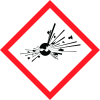


Note: Ingredients listed on restricted chemical lists
EC/CAS
204-289-6/118-96-7
Name of the chemical
2,4,6-Trinitrotoluol (und Isomeren in technischen Gemischen)
Concentration
00-4 31-50%
General Information
Revision date
2015-12-15
Product name
RIOBOOSTER / RIOSEIS / RIOSEIS P / RIOSEIS DE P
CAS No.
118-96-7
Emergency telephone
+ (44) 1246859366 (Only available during office hours; Monday-Friday; 08 00-18 00
Icons in SDS


Company Information
company name
Maxam UK, Ltd
GHS Information
Signal word
Danger
Hazard Codes
Hazard statements (CLP)
H201
Hazard statements
Code
Statements
H201
Explosive; mass explosion hazard
Section 2
2.1 Classification of the substance or mixture
In accordance with Regulation (EU) No 1272/2008: Acute Tox. 3 : Toxic in contact with skin or if inhaled. Acute Tox. 3 : Toxic if inhaled. Acute Tox. 3 : Toxic if swallowed, in contact with skin or if inhaled. Aquatic Chronic 2 : Toxic to aquatic life with long lasting effects. Expl. 1.1 : Explosive; mass explosion hazard. STOT RE 2 : May cause damage to organs through prolonged or repeated exposure.
2.2 Label elements
Labelling in accordance with Regulation (EU) No 1272/2008:
Signal word
Danger
Hazard statements
H201 Explosive; mass explosion hazard.
Precautionary statements
P280 Wear protective gloves/protective clothing/eye protection/face protection. P501 Dispose of contents/container in accordance with applicable local regulations
2.3 Other hazards
The product may have the following additional risks: Improper handling of the product may cause it to explode and this may lead to injuries due to projection of particles. These products may detonate in masse by shock, friction, fire, sparks, electrostatic discharges or sympathetic explosions, causing great surge pressure and heat. This can cause serious physical injuries and even death. Resulting fumes from the detonation or combustion are toxic and contain nitrogen oxides, (NOX) and odourless and colourless carbon oxides (CO and CO2). The symptoms caused by exposure to toxic fumes from the detonation are: headaches, nausea, fatigue, confusions and fainting. Inhalation can irritate the respiratory system and cause bronchitis, bronchopneumonia and even, in severe cases, pulmonary edema and death. Blasting of rocks can cause large fragments, in unstable positions, with risks of breaking off and flying parts. IMPORTANT: Do not use this product in work sites that contain or may contain flammable gases or powders. IMPORTANT: Surface and inside blasting can cause residual smoke to go through the subsoil to confined spaces (including tunnels, wells, basements, etc.) where it can accumulate and remain for a long time. If you have to enter them after an explosion, always follow the rules for entering confined spaces and check for the presence of toxic fumes before entering.


