



Note: Ingredients listed on restricted chemical lists
EC/CAS
211-063-0/55-63-0
Name of the chemical
Nitroglycerin; Propane-1,2,3-triyl trinitrate
Concentration
2.5-25%
EC/CAS
207-439-9/6484-52-2
Name of the chemical
Ammonium Nitrate (AN)
Concentration
25-75%
EC/CAS
200-240-8
Name of the chemical
Nitroglycerin; Propane-1,2,3-triyl trinitrate
Concentration
2.5-25%
EC/CAS
229-347-8
Name of the chemical
Ammonium nitrate (AN)
Concentration
25-75%
General Information
Revision date
2015-07-09
Product name
RIODIN HE - RIODIN XE
Emergency telephone
(Only available during office hours
Icons in SDS


Company Information
company name
MAXAM North America, Inc
GHS Information
Signal word
Danger
Hazard Codes
Hazard statements (CLP)
H201
Hazard statements
Code
Statements
H201
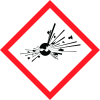
Explosive; mass explosion hazard
Section 2
2.1 Classification of the substance or mixture
In accordance with Directive 1999/45/EC: E - Extreme risk of explosion by shock, friction, fire or other sources of ignition. O - Contact with combustible material may cause fire. Danger of cumulative effects. Xi - Irritating to eyes. Harmful to aquatic organisms, may cause long-term adverse effects in the aquatic environment. T+ - Very toxic by inhalation, in contact with skin and if swallowed. In accordance with Regulation (EU) No 1272/2008: Acute Tox. 1 : Fatal in contact with skin or if inhaled. Acute Tox. 2 : Fatal if inhaled. Acute Tox. 2 : Fatal if swallowed, in contact with skin or if inhaled. Aquatic Chronic 3 : Harmful to aquatic life with long lasting effects. Expl. 1.1 : Explosive; mass explosion hazard. Eye Irrit. 2 : Causes serious eye irritation. Ox. Sol. 3 : May intensify fire; oxidiser. STOT RE 2 : May cause damage to organs through prolonged or repeated exposure.
2.2 Label elements
Labelling in accordance with Regulation (EU) No 1272/2008:
Signal word
Danger
Hazard statements
H201 Explosive; mass explosion hazard.
Precautionary statements
P280 Wear protective gloves/protective clothing/eye protection/face protection. P501 Dispose of contents/container in accordance with applicable local regulations
2.3 Other hazards
The product may have the following additional risks: Risks presented upon inhalation and contact with the skin, as well as ingestion, due to the nitroesther content. May cause headaches, nausea, dilation of peripheral blood vessels and a drop in blood pressure. May mass detonate as a result of: impact, friction, fire, spark or due to the vibration of a nearby explosion. Explosion produces a strong excess pressure and heat and may cause serious physical injury and even death. IMPORTANT: Do not use this explosive in jobs that contain or may contain flammable gases and/or powders. The smoke resulting from detonation and combustion is toxic. It contains nitrogen oxides (NOx) and odourless and colourless carbon oxides (CO and CO2). Symptoms caused by exposure to the detonation’s toxic fumes are: headache, nausea, fatigue, confusion and fainting. It may also cause irritation in the respiratory system, bronchitis, and bronchopneumonia; in serious cases, acute pulmonary oedema and death may result. IMPORTANT: In surface and interior explosions these residual fumes may migrate underground to confined spaces (including tunnels, wells, basements, etc.) where they accumulate and can remain for a long period of time. To enter these locations after an explosion, always follow the rules for entry into confined spaces and always verify that there are no toxic fumes present before entering. Rock blasting may produce large-sized fragments, in non-stable positions, with risks of landslides and aerial projections.


