

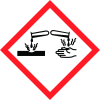
General Information
Revision date
2015-03-24
Product name
DEGREASE ALL E
1.2.1 Relevant identified uses
Professional Degreaser
1.2.2. Uses advised against
Use only as stated on label
Emergency telephone
1-800-535-5053
Icons in SDS


Company Information
company name
Legend Brands Products
GHS Information
Signal word
Danger
Section 2
SECTION 2: Hazards identification
OSHA \cute toxicitv - Oral !ot classified Ski n corrosion/irritation lateqory 1 lerious eve damaqe/eve irritation lateqory 1 \cute aquatic toxicitv lateqory 3 hronic aquatic toxicity lateqory 3
2.2 Label elements
Emerqencv Overview Danger
Hazard statements
Causes severe skin burns and eye damage Harmfulto aquatic life with long lasting effects P a g e 1 1 9
Prevention
- Do not breathe dust/fume/gas/misuvapors/spray - Wash face, hands and any exposed skin thoroughly afrer handling - Wear protective gloves/protective clothing/eye protectionfface protection - Avoid release to the environment
Response
- Specific Treatmenl (See Section 4 on the SDS) lF lN EYES: Rinse cautiously with wat€r for several minutes, Remove contact lenses, if present and easy to do. Continue rinsing. lmmedietely call a POISON CENTER or doctor/physician. lF ON SKIN (or hair): Remove/Take off immediately all contaminated clothing. Rinse skin with water/shower. Wash contaminated clothing before reuse. lF INHALED: Remove victim to fresh air and keep at rest in a position comfortable for breathing. lmmediately call a POISON CENTER or doctor/physician. lF SWALLOWED: Rinse mouth. DO NOT induce vomiting.
Storage
Store locked uo Conditions Keep container tightly closed in a dry and well-ventilated place. Keep out of the reach of children. Keep containers tightly closed in a dry, cool and well-ventilated place. Keep in properly labeled containers. Incompatible materials lncompatible with strong acids and bases. Incompatible with oxidizing agents. Strong acids. Aluminum. Control parameters Exposure Guidelines This product, as supplied, does not contain any hazardous materials with occupational exposure limits established by the region specific regulatory bodies. 2-butoxyethanol TWA: 20 ppm TWA: 50 ppm IDLH: 700 ppm 111-76-2 TWA: 240 mg/m' TWA: 5 ppm (vacated) TWA: 25 ppm ^ TWA: 24 mg/m' (vacated) TWA: 120 mg/m' (vacated) S* S* Sodium Hydroxide Ceiling: 2 mg/m' TWA: 2 mg/m" IDLH: 10 mg/m' 1310-73-2 (vacated) Ceilinq: 2 mq/m3 Ceilino: 2 mo/m" ATTOSH IDLH lmmediately Dangerous fo Life or Health
Precautionary statements
Disposal - Dispose of contents/container to an approved waste disposal plant Haza rds not otherwise classifiod IHNOCI
Further information
Unknown Acute Toxicity O% of the mixture consists of ingredient(s) of unknown toxicity Chemical Name CAS No. Weiqht-% Trade Secret 2-butoxvethanol 111-76-2 1-5 Octvlohenol Ethoxvlate 9036-19-5 1-5 Tetra ootassium Pvroohosohate 7320-34-5 1-5 Ammonium Hvdroxide 1336-21-6 1-1 First aid measures General advice lmmediate medical attention is required. Skin Contact lmmediate medical attention is required. Wash off immediately with soap and plenty of water while removing all contaminated clothes and shoes. For minor skin contact, avoid spreading material on unaffected skin. For severe burns, immediate medical attention is required. Eye contact lmmediate medical attention is required Rinse immediately with plenty of water, also under the eyelids , for at least 15 minutes Keep eye wide open while rinsing Do not rub affected area lmmediately flush with plenty of water. After initial flushing, remove any contact lenses and continue flushing for at least 15 minutes P a g e 2 1 9 Inhalation Remove to fresh air. Call a physician or poison control center immediately. lf not breathing, give artificial respiration. lf breathing is difficult, give oxygen. Ingestion lmmediate medical attention is required. Do NOT induce vomiting. Drink plenty of water. Never give anything by mouth to an unconscious person. Remove from exposure, lie down. Clean mouth with water and drink aftenrvards plenty of water. Call a physician or poison control center immediately. Self.protoction of ihe first aider Use personal protective equipment as required. Avoid contact with skin, eyes or clothing. Most imoortant svmptoms and effects. both acute and delaved Symptoms Any additional important symptoms and effects are described in Section 11: Toxicology Information. Indication of anv immediate medical aftention and special treatment needed Note to physicians Product is a corrosive material. Use of gastric lavage or emesis is contraindicated. Possible perforation of stomach or esophagus should be investigated. Do not give chemical antidotes. Asphp<ia from glottal edema may occur. Marked decrease in blood pressure may occur with moist rales, frothy sputum, and high pulse pressure. Treat symptomatically. Suitable extinouishino media Use extinguishing measures that are appropriate to local circumstances and the surrounding environment. Specific hazards arisinq from the chemical The product causes burns of eyes, skin and mucous membranes. Thermal decomposition can lead to release of irritating and toxic gases and vapors. In the event of fire and/or explosion do not breathe fumes. Protective equipment and precautions for firefiqhters As in any fire, wear self-contained breathing apparatus pressure-demand, MSHA/NIOSH (approved or equivalent) and full protective gear Personal Drecautions. orotective eouioment and emeroencv orocedures Personal precautions Evacuate personnel to safe areas. Use personal protective equipment as required. Avoid contact with skin, eyes or clothing. Keep people away from and upwind of spill/leak. Envi ronmental precautions Environmental precautions Do not allow into any sewer, on the ground or into any body of water. Should not be released into the environment. Prevent further leakage or spillage if safe to do so. Prevent product from entering drains. Methods and material for containment and cleaninq uo Methods for containment Prevent further leakage or spillage if safe to do so. Methods for cleaning up Dike far ahead of liquid spill for later disposal. Soak up with inert absorbent material. Take up mechanically, placing in appropriate containers for disposal. Clean contaminated surface thoroughly. Prevent product from entering drains. Dam up. After cleaning, flush away traces with water. Precautions for safe handlinq P a g e 3 / 9 Advice on safe handling Use personal protective equipment as required. Avoid contact with skin, eyes or clothing. Ensure adequate ventilation, especially in confined areas. In case of insufficient ventilation, wear suitable respiratory equipment. Use only with adequate ventilation and in closed systems. Conditions for safe storaqe. includinq anv incompatibilities Density Lbs/Gal 8.5 VOC Content (%) 4.81 Reactivitv No data available Stability Stable under recommended storage conditions. Possibility of Hazardous Reactions None under nolmal proc€ssing. Conditions to avoid Exposure lo air or moisture over prolonged periods. Incompatible materials Incompatible with strong acids and bases. lncompatible with oxidizing agents. Strong acids. Aluminum, Hazardous Decomposition ProduclsThermal decomposition can lead to release of initating and toxic gases and vapors. Information on likelv routes of exposure Product Information The primary effects and toxicity of this material are due to it corrosive nature. Inhalation Causes burns. Eye contact Corrosive to the eyes and may cause severe damage including blindness. Skin Contact The product causes burns of eyes, skin and mucous membranes. Ingestion Causes burns. P a g e 5 / 9 2-butoxyethanol = 470 mg/kg ( Rat ) = 99 mg/kg Rabbit ( ) = 4 5 0 p p m ( a ) h R t 4 111-76-2 Octylphenol Ethoxylate 1700 mg/kg ( Rat = ) 4190 mg/kg Yes 9036-1 9-5 { R a t ) Information on toxicoloqical effects Symptoms No Information available. Delaved and immediate effects as well as chronic effects from short and lonq-term exposure Corrosivity Gauses burns. Extremely corrosive and destructive to tissue. Risk of serious damage to eyes. Sensitization No lnformation available. Germ cell mutagenicity No lnformation available. Carcinogenicity The table below indicates whether each agency has listed any ingredient as a carcinogen. lhemical Name ACGIH IARC NTP
Remarks
Method pH 12.5 - 13.5 Specific Gravity 1.02 Viscosity Water Thin Melting poinUfreezing point No Information available Flash point Above 200'F Boiling point / boiling range No Information available Evaporation rate Same as water Flammability (solid, gas) Flammability Limits in Air Upper flammability limit: No Information available Lower flammability limit: No Information available Vapor pressure No Information available Vapor density No Information available Water solubility Soluble in water Partition coefficient No Information available Autoignition temperature No Information available Decom position tem peratu re No lnformation available
Aspiration hazard
No Information available. Numerical measures of toxicitv
Product information
Unknown Acute Toxicity 0% of the mixture consists of ingredient(s) of unknown toxicity The following values are calculated based on chapter 3.1 of the GHS document Component Inhalation LC50 - 4 hour - vapor - mg/L 2-butoxyethanol 450 111-76-2 ( 1-5 ) Ecotoxicitv Chemical Name Alqae/aquatic plants Fish Crustacea 2-butoxyethanol Yes 1490 96 h Lepomis macrochirus 1000 48 h Daphnia magna mg/L 111-76-2 mg/L LC50 static 2950: 96 h EC50 1698 - 1940: 24 h Daphnia Lepomis macrochirus mq/L LC50 maqna mo/L EC50 Tetra potassium Pyrophosphate Yes 100: 96 h Oncorhynchus mykiss 100: 48 h water flea mg/L EC50 7320-34-5 mq/L LC50 Ammonium Hydroxide Yes 8.2: 96 h Pimephales promelas 0.66: 48 h water flea mg/L EC50 1336-21-6 mg/L LC50 0.66: 48 h Daphnia pulex mg/L EC50 P a g e 6 / 9 Persistence and deqradabilitv No Information available. Bioaccumulation No lnformation available. Chemical Name Partition coefficient 2-butoxyethanol 0.81 111-76-2
Other hazards
No lnformation available Waste treatment methods Disposal of wastes Disposal should be in accordance with applicable regional, national and local laws and regulations. Gontaminated packaging Do not reuse container. US EPA Waste Number D002 This product contains one or more substances that are listed with the State of California as a hazardous waste. Chemical Name Galifornia Hazardous Waste Status Ammonium Hydroxide Toxic 1336-21-6 Corrosive Note: The basic description below is specific to the container size. This information is provided for at a glance DOT information. Please refer to the container and/or shipping papers for the appropriate shipping desciption before tendering this malerial for shipment. For addilional infofmation, please contact lhe distribulor listed in section 1 of this SDS. U.S. Department of Transportation (USDOD 4xl Gallon Case uN1760, CORROS/VE LIQUIDS, NOS, (CONTA|NS AMMONTUM HYDROX|DE AND DlsoDtuM rR/oxostLtcATE), 8, il (HM-c32L) Pails & Drums (<119 Gallons) uN1760, CORROS/VE L|QUIDS, NOS, (CONTAINS AMMONTUM HyDROX|DE AND DtsoDtuM rR/oxosILIOATE), 8, il (HM-CS2L) I nternationa I Inventories TSCA Complies DSL/NDSL Complies TSCA - United States Toxic Substances Control Act Section 8(b) lnventory DSLINDSL - Canadian Domeslic Subslancos LisrNon-Domesli4 Subsiances Lisl US Federal Requlations sRA3li! Section 313 of Title lll of the Superfund Amendmenls and Reauthorization Acl of 1986 (SARA). This product contains a chemical or chemicals which are subject to the reporting requirements ofthe Act and Title 40 of the Code of Federal Regulations, Part 372 P a g e 7 1 9 ]hemical Name SARA 313 - Threshold Values % 2-butoxvethanol - 1 1 1-76-2 SARA 311/312 Hazard Cateqories
Acute Health Hazards
Yes
Health hazards
Yes Fire hazard No Reactive Hazard No Sudden release of pressure hazard No CWA (Clean Water Act) This product does not contain any substances regulated as pollutants pursuant to the Clean Water Act (40 CFR 122.21 and 4A cFR 122.42) Ghemical Name CWA - Reportable CWA - Toxic Pollutants CWA - Priority Pollutants CWA - Hazardous Quantities Substances Ammonium Hydroxide 1000 tb 1336-21-6
Hazardous Ingredients
RQs CERCLA/SARA RQ Reportable Quantitv {RQl Ammonium Hydroxide 1000 tb RQ 1000 lb final RQ 1336-21-6 RQ 454 kq final RQ US State Requlations



