




General Information
Revision date
2020-07-31
Product name
provides a unique means by which the user can identify the
Product Synonyms
should be differ between “substances” and
CAS No.
1234-56-6
supplier name
Kommentiert [AH5]: Name
Icons in SDS
Company Information
company name
Kommentiert [AH5]: Name
Section 2
SECTION 2: Hazards identification
OSHA Classification of the chemical in accordance with paragraph (d) of §1910.1200 Acute toxicity (oral) Category 1-4 Acute toxicity (dermal) Category 1-4 Acute toxicity (Inhalation) Category 1-4 Kommentiert [AH7]: Differ between vapour, dust/mist, Skin corrosion Category 1, Sub-category 1A,1B, 1C gas Skin irritation Category 2 Eye damage Category 1 Eye irritation Sub-category 2A, 2B Respiratory sensitizer Category 1, Sub-category 1A, 1B Skin sensitizer Category 1, Sub-category 1A, 1B Mutagen Category 1A, 1B, 2 Carcinogen Category 1A, 1B, 2 Reproductive toxicant Category 1A, 1B, 2 Effects on or via lactation Category 1 Kommentiert [AH8]: APPENDIX A TO §1910.1200– HEALTH Target organ toxicity - single exposure Category 1-3 HAZARD CRITERIA Target organ toxicity - repeated exposure Category 1-2 Effects on or via lactation shall be classified in a separate single category. Chemicals that are absorbed by women and have been Aspiration toxicity Category 1 shown to interfere with lactation or that may be present (including Explosives Unstable explosive, Division 1.1-1.6 metabolites) in breast milk in amounts sufficient to cause concern Flammable gases Category 1-2 for the health of a breastfed child, shall be classified to indicate this property hazardous to breastfed babies. Flammable aerosols Category 1-2 Therefore instead of “no designated number” the “Category 1” Oxidizing gases Category 1 should be stated Gases under pressure Compressed gas, Liquified gas, Kommentiert [AH9] Alternative STOT SE, Category 1, 2 Dissolved gas, Refrigerated liquefied gas or 3 Flammable liquids Category 1-4 Kommentiert [AH10] Alternative STOT RE, Category 1 or Flammable solids Category 1-2 2 Self-reactive substances and mixtures Type A-G Pyrophoric liquids Category 1 Pyrophoric solids Category 1 Self-heating substances and mixtures Category 1-2 Substances or mixtures which, in contact with Category 1-3 water, emit flammable gases Oxidizing liquids Category 1-3 Oxidizing solids Category 1-3 Organic peroxides Type A-G Corrosive to metals Category 1 Pyrophoric gas Kommentiert [AH11]: OSHA defined hazards should appear Simple asphyxiant in section 2.1, not in section 2.3 Combustible dust Labeling according to US OSHA Hazard Communication Standard (29 CFR 1910.1200)
Hazard statements
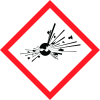
Kommentiert [AH12]: H-codes are not established in the US OSHA Hazard Communication standard Symbol(s)/Hazard pictograms Kommentiert [AH13]: C.2.1.2 If the skull and crossbones pictogram is included, the exclamation mark pictogram shall not appear where it is used for acute toxicity; it may appear if it is triggered by Skin/Eye irritation (Emergency overview) Kommentiert [AH14]: ANSI Z.400 standard suggests an emergency overview in this early part of the SDS: should include the
Precautionary statements
appearance (color, physical state) and odor together with the hazard statements. Note that ANSI-approved standards are voluntary, however some of the content of these standards are incorporated Other labeling into state and/or federal regulation "by reference" meaning that the regulations refer the reader to the standards without restating them. The current ANSI SDS standard is ANSI Z400.1/Z129.1-2010, but
Supplemental label elements
with HCS 2012 now in full regulatory effect and the GHS being “x % of the mixture consists of ingredient(s) of unknown acute toxicity” continuously being refined by the United Nations, it is not clear what, “x % of the mixture consists of ingredient(s) of unknown acute oral toxicity” if any, purpose Z400.1 currently has as it is not incorporated by reference in HCS 2012, but is rather partially derived/descended “x % of the mixture consists of ingredient(s) of unknown acute dermal toxicity” from it. “x % of the mixture consists of ingredient(s) of unknown acute inhalation toxicity” Kommentiert [AH15]: All P-statements must be shown. These are commonly organized into categories such as prevention, Right-To-Know laws response, storage, disposal. P-codes are not established in the US New Jersey (NJ): OSHA Hazard Communication standard “Contents unknown” Kommentiert [AH16]: OSHA recommends following GHS Revision 4 guidance, see https://www.osha.gov/laws-
Contains
Partially Unknown” regs/standardinterpretations/2015-03-24
2.3 Other hazards
Kommentiert [AH17]: An adverse physical or health effect identified through evaluation of scientific evidence during the The substance is an endocrine disruptor. classification process that does not meet the specified criteria for the physical and health hazard classes addressed in this section. This does not extend coverage to adverse physical and health effects for which there is a hazard class addressed in this section, but the effect either falls below the cut-off value/concentration limit of the hazard class or is under a GHS hazard category that has not been adopted by OSHA (e.g., acute toxicity Category 5). These do not have to appear on the product label


