



Note: Ingredients listed on restricted chemical lists
EC/CAS
231-159-6/7440-50-8
Name of the chemical
Copper
Concentration
60%
EC/CAS
200-240-8/55-63-0
Name of the chemical
Nitroglycerin; Propane-1,2,3-triyl trinitrate
Concentration
60%
EC/CAS
200-240-8/9004-70-0
Name of the chemical
Nitrocellulose
Concentration
2% 20%
EC/CAS
239-290-0/15245-44-0
Name of the chemical
Blei-2,4,6-trinitroresorcinat
Concentration
0 - 1.5
EC/CAS
231-100-4
Name of the chemical
Blei, massiv: [Partikeldurchmesser ≥ 1 mm]
Concentration
0.5-70% 92-1 1.5%
EC/CAS
231-146-5
Name of the chemical
Antimony
Concentration
0 - 1.5 %
General Information
Version
0
Revision date
2017-01-12
Product name
CARTRIDGE—CENTERFIRE
Product Synonyms
Nickel .40 S&W Full Metal Jacket, .38 Special Round Nose Lead Bullet, .380 Auto
1.2.1 Relevant identified uses
of the hazardous chemical Cartridges for competition or mixture, and restrictions on use
1.2.2. Uses advised against
Uses other than those recommended U.N. Dangerous Goods Class Cartridge 1.4S TELEPHONE NUMBER IN CASE OF (52) ( 777) 329 26 26, (52) (777)382 02 05,
Emergency telephone
(52)(777) 382 02 41, (52) 01 800 310 4040
Icons in SDS


Company Information
company name
Industrias Tecnos S.A. de C.V
GHS Information
Signal word
Danger
Hazard Codes
Hazard statements (CLP)
H204, H360, H372, H411
Hazard statements
Code
Statements
H204
Fire or projection hazard
H360
May damage fertility or the unborn child
H372
Causes damage to organs through prolonged or repeated exposure
H411
Toxic to aquatic life with long lasting effects
Section 2
SECTION 2: Hazards identification
EMERGENCY OVERVIEW: EXPLOSIVE. KEEP AWAY FROM HEAT. DO NOT SUBJECT TO MECHANICAL SHOCK. PARTICLES FROM FIRING MAY BE HARMFUL IF INHALED. DO NOT TAKE INTERNALLY.
Hazard statements
SYMBOS Issued on: 25-January-2017 GHS Explosive Division 1.4 H372: Causes damage to nervous system, kidney, and hematopoietic system through prolonged or repeated exposure H360: May damage fertility or the unborn child H411: Toxic to aquatic life with long lasting effects Target organs: Nervous, renal and hematopoietic systems P102: Keep out of reach of children P210: Keep away from heat/sparks/open flame/hot surfaces P250: Do not subject to shock/friction P260: Do not breathe fumes P264: Wash hands thoroughly after handling P270: Do not eat, drink or smoke when using this
2.1 Classification of the substance or mixture
STOT RE Category 1 Reproductive Toxicity Category 1A Aquatic Environment, Chronic II Keyword DANGER H204: Fire or projection hazard
Precautionary statements
product P271: Use only outdoors or in a well-ventilated area P273: Avoid release to the environment P280: Wear /protective clothing/eye protection/ hearing protection P370+P380: In case of fire: Evacuate area P374: Fight fire with normal precautions from a reasonable distance P410: Store in accordance with local regulations P501: Dispose of contents in accordance with local regulations
Hazard pictograms
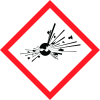
Explosive; Pictogram: exploding bomb Specific Target Organ Toxicity; Pictogram Code: GHS08 Environment; Pictogram Code: GHS09 EU Classifications: E, T, N Risk R2 Risk of explosion by shock, friction, fire or other Phrases sources of ignition R48: Danger of serious damage to health by prolonged exposure R60: May impair fertility R63: Possible risk of harm to the unborn child R51/53: Toxic to aquatic organisms and many cause long-term adverse effects in the aquatic
Environmental hazards
Health Hazards or Risks From Exposure This product is made up of a finished metal alloy cartridge containing the various fully sold components inside. Therefore, under normal handling of this product, no exposure to harmful materials is produced. When the ammunition is fired, a small amount of the particles can be generated which may be slightly irritating to the eyes and respiratory tract. Particles may contain traces of these harmful substances: Issued on: 25-January-2017 Lead: Ingestion of large amounts of lead can cause abdominal pain, constipation, cramps, nausea and / or vomiting. Chronic exposure to lead can cause kidney damage, anemia, reproductive effects, developmental effects and permanent damage of the nervous system in humans, changes in cognitive function. Nitroglycerin: Production of dilated blood vessels and decreased blood pressure that can affect the heart. It has also been shown to cause methemoglobinemia (cyanosis). Copper: Inhalation of high concentrations of metallic copper dust or vapors may cause nasal irritation and / or nausea, vomiting and stomach pain It is unlikely that the amount of particles that someone is exposed to trigger a charged round would be enough to cause any of these effects.


