





Note: Ingredients listed on restricted chemical lists
EC/CAS
7440-50-8
Name of the chemical
Copper
Concentration
30 - 85 %
EC/CAS
200-240-8/9004-70-0
Name of the chemical
Nitrocellulose
Concentration
5 - 20 %
EC/CAS
200-240-8/55-63-0
Name of the chemical
Nitroglycerin; Propane-1,2,3-triyl trinitrate
Concentration
2 %
EC/CAS
231-175-3/7440-66-6
Name of the chemical
Zinc
Concentration
2 - 4 %
General Information
Version
1.0
Revision date
2021-01-12
Product name
Hornady Ammunition Utilizing Monolithic Projectiles
Product name
Hornady Ammunition Utilizing Monolithic Projectiles
Identification on the label/Trade name
Applies to any Hornady centerfire rifle or pistol ammunition loaded with CX, ECX, GMX , ETX , or MonoFlex bullets
supplier name
Hornady Mfg. Co
Emergency telephone
(800) 424-9300, (703) 527-3887
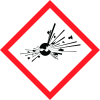
Icons in SDS


Company Information
company name
Hornady Mfg. Co
GHS Information
Signal word
Warning
Hazard Codes
Hazard statements (CLP)
H204, H301, H311, H317, H332, H373, H412
Hazard statements
Code
Statements
H204
Fire or projection hazard
Section 2
SECTION 2: Hazards identification
Hazard statements
HEALTH HAZARDS/RISKS FROM EXPOSURE This product is a finished metal alloy cartridge, which contains the various components completely sealed within. Therefore, under normal handling of this product, no exposure to any harmful materials is expected to occur. When the ammunition is fired, a small amount of particles may be generated which may be slightly irritating to the eyes and the respiratory tract. The particles may contain trace amounts of these harmful substances, however, it is unlikely that the amount of particles from firing a loaded round would be sufficient to cause any of these effects. COPPER Inhalation of high concentrations of metallic copper dusts or fumes may cause nasal irritation and/or nausea, vomiting and stomach pain. NITROGLYCERIN Will produce dilation of blood vessels and drop in blood pressure that may affect the heart. It has also been shown to cause methemoglobinemia (cyanosis) Classification of the substance or mixture H301 Toxic if swallowed H311 Toxic in contact with skin H332 Harmful if inhaled H373 May cause damage to organs through prolonged or repeated exposure H204 Fire or projection hazard H412 Harmful to aquatic life with long lasting effects H317 May cause an allergic skin reaction
Signal word
Warning
Precautionary statements
P260 Do not breathe dust/fume/gas/mist/vapors/spray. P261 Avoid breathing dust/fume/gas/mist/vapors/spray. P264 Wash … thoroughly after handling. P270 Do not eat, drink or smoke when using this product. P271 Use only outdoors or in a well-ventilated area. P280 Wear protective gloves/protective clothing/eye protection/face protection. P301+P310 IF SWALLOWED: Immediately call a POISON CENTER/doctor/... P302+P352 IF ON SKIN: Wash with plenty of water/... P304+P340 IF INHALED: Remove person to fresh air and keep comfortable for breathing. P312 Call a POISON CENTER/doctor/.../ if you feel unwell. P314 Get medical advice/attention if you feel unwell. P321 Specific treatment (see … on this label). P330 Rinse mouth. P361+P364 Take off immediately all contaminated clothing and wash it before reuse. P405 Store locked up. P501 Dispose of contents/container in accordance with local, regional, national, and/or international regulations. P210 Keep away from heat/sparks/open flames/hot surfaces. No smoking. P250 Do not subject to grinding/shock/.../friction. P273 Avoid release to the environment. P370+P280 In case of fire: Evacuate area. P374 Fight fire with normal precautions from a reasonable distance. P272 Contaminated work clothing must not be allowed out of the workplace. P333+P313 If skin irritation or rash occurs: Get medical advice/attention. P363 Wash contaminated clothing before reuse.
2.1 Classification of the substance or mixture
GHS classification in accordance with: OSHA (29 CFR 1910.1200) - Acute toxicity, dermal, Cat. 3 - Acute toxicity, inhalation, Cat. 4 - Acute toxicity, inhalation, Cat. 5 - Acute toxicity, oral, Cat. 3 - Specific target organ toxicity (repeated exposure), Cat. 2 - Sensitization, skin, Cat. 1A


