


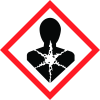
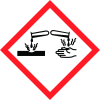
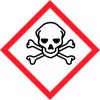
Note: Ingredients listed on restricted chemical lists
EC/CAS
231-639-5/7664-93-9
Name of the chemical
sulphuric acid
Concentration
50≤x<100
EC/CAS
231-992-5/7783-35-9
Name of the chemical
Mercuric sulfate
Concentration
0.5≤x<1
EC/CAS
231-906-6/7778-50-9
Name of the chemical
Potassium dichromate
Concentration
0.25≤x<0.5
General Information
Version
5
Revision date
2021-04-27
Product name
COD MR Reagent
Product name
COD MR Reagent
Identification on the label/Trade name
Hanna Instruments S.R.L
1.2.1 Relevant identified uses
Determination of Chemical Oxygen Demand in Water Samples - EPA Method
Emergency telephone
+1 8004249300, +1 7035273887
Icons in SDS


Company Information
company name
Hanna Instruments, Inc
e-mail address of the competent person responsible for the Safety Data Sheet
msds@hanna.ro, sds@hannainst.com
GHS Information
Signal word
Danger
Hazard Codes
Hazard statements (CLP)
H290, H300, H311, H314, H317, H332, H334, H340, H350, H360, H373
Hazard statements
Code
Statements
H290
May be corrosive to metals
Section 2
SECTION 2: Hazards identification
1272/2008 Classification of the substance or mixture
Signal word
Danger Hazard statements H290 May be corrosive to metals H350 May cause cancer H340 May cause genetic defects H360 May damage fertility or the unborn child H300 Fatal if swallowed H311 Toxic in contact with skin H332 Harmful if inhaled H373 May cause damage to organs through prolonged or repeated exposure H314 Causes severe skin burns and eye damage H334 May cause allergy or asthma symptoms or breathing difficulties if inhaled H317 May cause an allergic skin reaction
Prevention
P201 Obtain special instructions before use. P260 Do not breathe dust, fume, gas, mist, vapours, spray. P280 Wear protective gloves / protective clothing / eye protection / face protection. --
Response
P310 Immediately call a POISON CENTER or doctor. P303+P361+P353 IF ON SKIN (or hair): Take off immediately all contaminated clothing. Rinse skin with water / shower. P304+P340 IF INHALED: Remove person to fresh air and keep comfortable for breathing. P305+P351+P338 IF IN EYES: Rinse cautiously with water for several minutes. Remove contact lenses, if present and easy to do. Continue rinsing. P391 Collect spillage. --
Storage
- --
Disposal
- -- Additional hazards Information not available
Hazard statements
H412 Harmful to aquatic life with long lasting effects.
2.1 Classification of the substance or mixture
The product is classified as hazardous pursuant to the provisions set forth in OSHA Hazard Communication Standard (HCS) (29 CFR 1910.1200). The product thus requires a safety datasheet. Any additional information concerning the risks for health and/or the environment are given in sections 11 and 12 of this sheet. Classification and Hazard Statement Substance or mixture corrosive to metals, category May be corrosive to metals. 1 Carcinogenicity, category 1B May cause cancer. Germ cell mutagenicity, category 1B May cause genetic defects. Reproductive toxicity, category 1B May damage fertility or the unborn child. Acute toxicity, category 2 Fatal if swallowed. Acute toxicity, category 3 Toxic in contact with skin. Acute toxicity, category 4 Harmful if inhaled. Specific target organ toxicity - repeated exposure, May cause damage to organs through prolonged or repeated category 2 exposure. Skin corrosion, category 1 Causes severe skin burns and eye damage. Serious eye damage, category 1 Causes serious eye damage. Respiratory sensitization, category 1 May cause allergy or asthma symptoms or breathing difficulties if inhaled. Skin sensitization, category 1 May cause an allergic skin reaction. Hazard pictograms



