

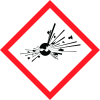


General Information
Revision date
2011-01-04
Product name
PERCUSSION PRIMER - HI-TEMP ASSEMBLY
1.2.1 Relevant identified uses
Explosive Charge
Icons in SDS


Company Information
company name
Halliburton Energy Services
e-mail address of the competent person responsible for the Safety Data Sheet
fdunexchem@halliburton.com
GHS Information
Signal word
Danger
Hazard Codes
Hazard statements (CLP)
H204, H271, H302
Hazard statements
Code
Statements
H204
Fire or projection hazard
Section 2
2.1 Classification of the substance or mixture
REGULATION (EC) No 1272/2008 Acute Oral Toxicity Category 4 - (H302) Explosives. Division 1.4 - (H204) Oxidizing solids Category 1 - (H271)
EU Classification
Directives 67/548/EEC or 1999/45/EC For the full text of the R-phrases mentioned in this Section, see Section 16
Classifications
O - Oxidizing. Xn - Harmful.
Hazard statements
R9 Explosive when mixed with combustible material. R22 Harmful if swallowed. H302 - Harmful if swallowed H204 - Fire or projection hazard H271 - May cause fire or explosion; strong oxidizer
Signal word
Danger
Contains
Substances CAS Number Titanium potassium perchlorate Mixture
Precautionary statements
P210 - Keep away from heat/sparks/open flames/hot surfaces. - No smoking P220 - Keep/Store away from clothing/other combustible materials P221 - Take any precaution to avoid mixing with combustibles P240 - Ground/Bond container and receiving equipment P250 - Do not subject to grinding/shock/friction P264 - Wash face, hands and any exposed skin thoroughly after handling P270 - Do not eat, drink or smoke when using this product P280 - Wear protective gloves/protective clothing/eye protection/face protection P283 - Wear fire/flame resistant/retardant clothing P301+ P312 - IF SWALLOWED: Call a POISON CENTER or doctor/physician if you feel unwell P330 - Rinse mouth P306 + P360 - IF ON CLOTHING: Rinse immediately contaminated clothing and skin with plenty of water before removing clothes P371 + P380 + P375 - In case of major fire and large quantities: Evacuate area. Fight fire remotely due to the risk of explosion P370 + P380 - In case of fire: Evacuate area P372 - Explosion risk in case of fire P373 - DO NOT fight fire when fire reaches explosives
2.3 Other hazards
None known


