



Note: Ingredients listed on restricted chemical lists
EC/CAS
21645-51-2
Name of the chemical
Aluminium hydroxide
Concentration
10 - 30
EC/CAS
78-40-0
Name of the chemical
Phosphoric acid, triethyl ester, TEP
Concentration
2 - 10
EC/CAS
14808-60-7
Name of the chemical
Silica, crystalline
Concentration
0.1 - 5
General Information
Revision date
2015-09-21
Product name
FireOut
Manufacturer Name
GAF
Emergency telephone
800 – 424 – 9300
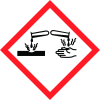
Icons in SDS


Company Information
company name
GAF
GHS Information
Signal word
Warning
Section 2
SECTION 2: Hazards identification
GHS Classification NFPA and HMIS RATINGS: NFPA Hazard HMIS Hazard Rating Health 1 Health 1 Flammable 1 Flammable 1 Reactive 0 Reactive 0 Special Hazards - Personal Protection X
2.1 Classification of the substance or mixture
Eye Irritant - Category 2A Skin Irritant - Category 2 Eye Damage - Category1 Skin Corrosive - 1A Skin Sensitizer - Category 1 Respiratory Irritant Mutagenicity - Category 1B Carcinogen - Category 1A Acute Toxicity - Category 4 Target Organ (SE) - Category 3 Hazardous to the Aquatic Environment (chronic) - Category 3
Signal word
Warning
Hazard statements
May cause damage to organs through prolonged or repeated exposure Causes skin irritation Serious eye irritation May cause genetic defects May cause cancer Harmful if swallowed May cause respiratory irritation Repeated exposure may cause skin dryness and cracking May cause an allergic skin reaction May be corrosive to metals Harmful to aquatic life with long lasting effects ADDITIONAL HAZARD IDENTIFICATION INFORMATION:
Principle Routes of Exposure
Inhalation, Skin contact SIGNS & SYMPTOMS OF EXPOSURE EYES: Irritation, itching. SKIN: Slight irritation, itching. INGESTION: Not likely to occur. INHALATION: Vapors or mists can cause irritation, headaches, and nausea.
Acute Health Hazards
Irritation.
Health hazards
Studies in humans have found that exposure to respirable crystalline silica (quartz) can cause silicosis, a fibrosis (scarring) of the lungs. Silicosis is a serious and irreversible disease; it may be progressive even after exposure has ceased; it can lead to disability and death. Human studies also have found that silicosis is a risk factor for tuberculosis, and that occupational exposure to respirable crystalline silica is associated with chronic obstructive pulmonary disease, including bronchitis and emphysema. Some studies show excess numbers of cases of scleroderma, connective tissue disorders, lupus, rheumatoid arthritis, chronic kidney diseases and end-stage kidney disease in workers exposed to respirable crystalline silica. CARCINOGENICITY: Occupational exposure to respirable crystalline silica is classified as a known carcinogen in humans. IARC has determined that respirable crystalline silica is carcinogenic to humans (Group 1), based on findings of sufficient evidence of carcinogenicity in both humans and experimental animals. NTP has classified respirable crystalline silica as a known human carcinogen based on sufficient evidence of carcinogenicity from studies in humans indicating a causal relationship between exposure to respirable crystalline silica and increased lung cancer rates in workers exposed to crystalline silica dust. NIOSH has determined that respirable crystalline silica is a potential occupational carcinogen. Sulfuric acid contained in strong inorganic acids mists is classified as a group 1 carcinogen (carcinogenic to humans) by the International Agency for Research on Cancer (IARC).



