

General Information
Product name
Pyrotechnic articles for vehicles (micro gas generators / air bag inflators / air bag modules / seat-belt pretension- ers / actuators / igniters / semi-finished products), hereafter called articles
1.2.1 Relevant identified uses
of the articles and uses advised against These articles shall only be used for safety devices in vehicles
Emergency telephone
49 (0) 221-90-33333 (Mo. - Fr. 09 00 - 16 00
Icons in SDS

Company Information
company name
Ford-Werke GmbH
e-mail address of the competent person responsible for the Safety Data Sheet
HSE@rle.de
GHS Information
Signal word
Warning
Hazard Codes
Hazard statements (CLP)
H204
Hazard statements
Code
Statements
H204
Fire or projection hazard
Section 2
SECTION 2: Hazards identification
These articles contain pyrotechnic components that are hermetically sealed off from the environment. These cannot be released under normal or reasonably foreseeable conditions of use including proper disposal. Inte- grated compressed gas containers: gases are under high pressure. Articles featuring unpressurized containers still may contain pyrotechnic components. Classification of the article Pyrotechnic article (explosive article, 1.4) H204: Fire or projection hazard.
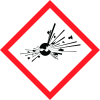
Hazard pictograms
GHS 01
Signal word
Warning
Hazard statements
H204: Fire or projection hazard.
Precautionary statements
P210: Keep away from heat/sparks/open flames/hot surfaces. – No smoking. P250: Do not subject to grinding/shock/drop/friction. P370+380 In case of fire Evacuate area P374: Fight fire with normal precautions from a reasonable distance.
2.3 Other hazards
Risk of uncontrolled activation in case of fire, heat, electrostatic discharge, induction through electromagnet- ic fields, or greater mechanical load (e.g. shocks or falls). Risk from hazardous projectiles, quickly moving parts and/or high-speed gas beams released through acti- vation. Risk of burn injuries in case of direct contact with articles heated by activation or with their reaction products (particles and gases). Risk of fire development if articles heated by activation come into contact with combustible or flammable material. Risk of eye and respiratory tract irritation from reaction products. Risk of blast trauma from high-volume noise impulses during activation. Risk of frostbite injuries from released gases that are stored under high pressure.


