

Note: Ingredients listed on restricted chemical lists
EC/CAS
1310-73-2
Name of the chemical
sodium hydroxide
Concentration
N/A
EC/CAS
215-185-5
Name of the chemical
Potassium or sodium hydroxide (20)
Concentration
N/A
General Information
Revision date
2016-04-20
Product name
Sodium Hydroxide
CAS No.
1310-73-2
1.2.1 Relevant identified uses
Laboratory chemicals
1.2.2. Uses advised against
No further relevant information available
Icons in SDS
Company Information
company name
Electron Microscopy Sciences
e-mail address of the competent person responsible for the Safety Data Sheet
sgkcck@aol.com
GHS Information
Signal word
Danger
Hazard Codes
Hazard statements (CLP)
H290, H314, H318
Hazard statements
Code
Statements
H290
May be corrosive to metals
Section 2
2.1 Classification of the substance or mixture
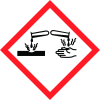
GHS05 corrosion Met. Corr.1 H290 May be corrosive to metals. Skin Corr. 1A H314 Causes severe skin burns and eye damage. Eye Dam. 1 H318 Causes serious eye damage.
2.2 Label elements
The substance is classified and labelled according to the Globally Harmonised System (GHS).
Hazard pictograms
GHS05
Signal word
Danger
Hazard statements
May be corrosive to metals. Causes severe skin burns and eye damage.
Precautionary statements
Do not breathe dusts or mists. Wear eye protection / face protection. Keep only in original container. Wash thoroughly after handling. IF ON SKIN (or hair): Take off immediately all contaminated clothing. Rinse skin with water/shower. IF IN EYES: Rinse cautiously with water for several minutes. Remove contact lenses, if present and easy to do. Continue rinsing. Immediately call a POISON CENTER/doctor. Specific treatment (see on this label). IF INHALED: Remove person to fresh air and keep comfortable for breathing. Wash contaminated clothing before reuse. IF SWALLOWED: rinse mouth. Do NOT induce vomiting. Absorb spillage to prevent material damage. Store locked up. Store in corrosive resistant container with a resistant inner liner. Dispose of contents/container in accordance with local/regional/national/international regulations.
PBT Substances
Not applicable
vPvB Substances
Not applicable



