




Note: Ingredients listed on restricted chemical lists
EC/CAS
108-88-3
Name of the chemical
Toluene
Concentration
13-30%
EC/CAS
123-86-4
Name of the chemical
acetic acid, butyl ester
Concentration
13-30%
EC/CAS
9004-70-0
Name of the chemical
Nitrocellulose
Concentration
5-7%
EC/CAS
14808-60-7
Name of the chemical
Silica, crystalline
Concentration
1.5-5%
EC/CAS
141-78-6
Name of the chemical
acetic acid, ethyl ester
Concentration
1.5-5%
EC/CAS
1330-78-5
Name of the chemical
Tris(methylphenyl) phosphate
Concentration
1-1.5%
General Information
Revision date
2017-04-11
Product name
Eastwood EW-16109ZP Black Etch Primer RTS
1.2.1 Relevant identified uses
Coating
Icons in SDS


Company Information
company name
eastwood company
GHS Information
Signal word
Danger
Hazard Codes
Hazard statements (CLP)
H200, H225, H302, H315, H319, H336, H350, H361, H370, H373
Hazard statements
Code
Statements
H200
Unstable explosive
H225
Highly flammable liquid and vapour
H302
Harmful if swallowed
H315
Causes skin irritation
H319
Causes serious eye irritation
H336
May cause drowsiness or dizziness
H350
May cause cancer
H361
Suspected of damaging fertility or the unborn child
H370
Causes damage to organs
H373
May cause damage to organs through prolonged or repeated exposure
Section 2
2.1 Classification of the substance or mixture
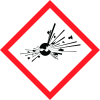
GHS01 Exploding bomb Unst. Expl. H200 Unstable explosive. GHS02 Flame Flam. Liq. 2 H225 Highly flammable liquid and vapor. GHS08 Health hazard Carc. 1A H350 May cause cancer. Repr. 2 H361 Suspected of damaging fertility or the unborn child. STOT SE 1 H370 Causes damage to organs. STOT RE 2 H373 May cause damage to organs through prolonged or repeated exposure. GHS07 Acute Tox. 4 H302 Harmful if swallowed. Skin Irrit. 2 H315 Causes skin irritation. Eye Irrit. 2A H319 Causes serious eye irritation. STOT SE 3 H336 May cause drowsiness or dizziness.
2.2 Label elements
The product is classified and labeled according to the Globally Harmonized System (GHS) (Contd. on page 2) USA (Contd. of page 1)
Hazard pictograms
GHS01 GHS02 GHS07 GHS08
Signal word
Danger
Hazardous Ingredients
toluene CELLULOSE NITRATE Quartz (SiO2) acetone
Hazard statements
H200 Unstable explosive. H225 Highly flammable liquid and vapor. H302 Harmful if swallowed. H315 Causes skin irritation. H319 Causes serious eye irritation. H350 May cause cancer. H361 Suspected of damaging fertility or the unborn child. H370 Causes damage to organs. H336 May cause drowsiness or dizziness. H373 May cause damage to organs through prolonged or repeated exposure.
Precautionary statements
P210 Keep away from heat/sparks/open flames/hot surfaces. No smoking. P241 Use explosion-proof electrical/ventilating/lighting/equipment. P260 Do not breathe dust/fume/gas/mist/vapors/spray. P280 Wear protective gloves/protective clothing/eye protection/face protection. P281 Wear personal protective equipment/face protection. P240 Ground/bond container and receiving equipment. P233 Keep container tightly closed. P242 Use only non-sparking tools. P243 Take precautionary measures against static discharge. P264 Wash thoroughly after handling. P270 Do not eat, drink or smoke when using this product. P201 Obtain special instructions before use. P202 Do not handle until all safety precautions have been read and understood. P303+P361+P353 If on skin (or hair): Take off immediately all contaminated clothing. Rinse skin with water/ shower. P305+P351+P338 If in eyes: Rinse cautiously with water for several minutes. Remove contact lenses, if present and easy to do. Continue rinsing. P373 DO NOT fight fire when fire reaches explosives. P321 Specific treatment (see on this label). P380 Evacuate area. P301+P312 IF SWALLOWED: Call a POISON CENTER/doctor if you feel unwell. P372 Explosion risk in case of fire. P308+P313 IF exposed or concerned: Get medical advice/attention. P332+P313 If skin irritation occurs: Get medical advice/attention. P337+P313 If eye irritation persists: Get medical advice/attention. P314 Get medical advice/attention if you feel unwell. P330 Rinse mouth. (Contd. on page 3) USA (Contd. of page 2) P370+P378 In case of fire Use for extinction CO2, powder or water spray P362+P364 Take off contaminated clothing and wash it before reuse. P401 Store in accordance with local/regional/national/international regulations. P405 Store locked up. P403+P235 Store in a well-ventilated place. Keep cool. P501 Dispose of contents/container in accordance with local/regional/national/international regulations.
Classification system
NFPA ratings (scale 0 - 4) Health = 1 3 Fire = 3 1 4 Reactivity = 4 · HMIS-ratings (scale 0 - 4) HEALTH *1 Health = *1 FIRE 3 Fire = 3 REACTIVITY 4 Reactivity = 4
PBT Substances
Not applicable
vPvB Substances
Not applicable *


