




Note: Ingredients listed on restricted chemical lists
EC/CAS
6484-52-2
Name of the chemical
Ammonium Nitrate (AN)
Concentration
62-72
EC/CAS
78-11-5
Name of the chemical
Pentaerithrityl tetranitrate (INN)
Concentration
0.5-3
General Information
Revision date
2025-05-01
Product name
DYNOSPLIT EX; DYNOSPLIT RiGHT
Emergency telephone
800-424-9300
Icons in SDS


Company Information
company name
Dyno Nobel LTD
e-mail address of the competent person responsible for the Safety Data Sheet
dna.healthsafety@am.dynonobel.com
GHS Information
Signal word
Danger
Hazard Codes
Hazard statements (CLP)
H201, H272, H304, H315, H319, H350
Hazard statements
Code
Statements
H201
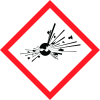
Explosive; mass explosion hazard
Section 2
SECTION 2: Hazards identification
Classification (GHS-US) Classification of the Substance or Mixture Classification (GHS-US) Expl. 1.1 Ox. Sol. 3 Skin Irrit. 2 Eye Irrit. 2A Carc. 1B Asp. Tox. 1 H201 H272 H315 H319 H350 H304
2.2 Label elements
GHS-US Labeling
Hazard pictograms
GHS01 GHS03 GHS07 GHS08
Signal word
Danger
Hazard statements
H201 - Explosive; mass explosion hazard. H272 - May intensify fire; oxidizer. H304 - May be fatal if swallowed and enters airways. H315 - Causes skin irritation. H319 - Causes serious eye irritation. H350 - May cause cancer.
Precautionary statements
P201 - Obtain special instructions before use. P202 - Do not handle until all safety precautions have been read and understood. P210 - Keep away from open flames, sparks, heat, hot surfaces. - No smoking. P220 - Keep/Store away from combustible material, oxidizable materials, and incompatible materials. P221 - Take any precaution to avoid mixing with combustible material, oxidizable materials, and incompatible materials. P230 - Keep wetted with not less than 30% water. P240 - Ground/bond container and receiving equipment. P250 - Do not subject to grinding, friction, shock. P264 - Wash hands, forearms, and exposed areas thoroughly after handling. P280 - Wear eye protection, protective clothing, protective gloves. P301+P310 - If swallowed: Immediately call a poison center or doctor. P302+P352 - If on skin: Wash with plenty of water. P305+P351+P338 - IF IN EYES: Rinse cautiously with water for several minutes. Remove contact lenses, if present and easy to do. Continue rinsing. P308+P313 - If exposed or concerned: Get medical advice/attention. P321 - Specific treatment (see Section 4 on this SDS). P331 - Do NOT induce vomiting. P332+P313 - If skin irritation occurs: Get medical advice/attention. P337+P313 - If eye irritation persists: Get medical advice/attention. P362 - Take off contaminated clothing and wash before reuse. P370+P378 - In case of fire: Use appropriate media (see section 5) to extinguish. P370+P380 - In case of fire: Evacuate area. P372 - Explosion risk in case of fire. P373 - DO NOT fight fire when fire reaches explosives. P401 - Store in accordance with in accordance with, local, regional, national, territorial, provincial, and international regulations. P405 - Store locked up. P501 - Dispose of contents/container in accordance with local, regional, national, territorial, provincial, and international regulations.
2.3 Other hazards
Not available
Other hazards
Toxic hepatitis, aplastic anemia, methemoglobinemia, hemolytic anemia, and cataracts have been reported after occupational exposure. Methemoglobinemia decreases the blood's ability to carry oxygen and results in symptoms such as dizziness, drowsiness, headache, shortness of breath, blue skin and lips, rapid heart rate, unconsciousness, and possibly death
2.1 Classification of the substance or mixture
Classification (GHS-US) Expl. 1.1 H201 Ox. Sol. 3 H272 Skin Irrit. 2 H315 Eye Irrit. 2A H319 Carc. 1B H350 Asp. Tox. 1 H304


