

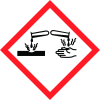


Note: Ingredients listed on restricted chemical lists
EC/CAS
7632-00-0
Name of the chemical
Sodium nitrite
Concentration
N/A
EC/CAS
1330-43-4
Name of the chemical
Disodium tetraborate
Concentration
N/A
EC/CAS
2492-26-4
Name of the chemical
2(3H)-Benzothiazolethione,sodium salt (1:1)
Concentration
N/A
General Information
Revision date
2016-11-11
Product name
UCA-4
1.2.1 Relevant identified uses
Coolant Blending Syrup
Emergency telephone
1-813-248-0585 / 1-800-255-3924
Icons in SDS
Company Information
company name
Dober
e-mail address of the competent person responsible for the Safety Data Sheet
regulatory@dober-group.com
GHS Information
Signal word
Danger
Hazard Codes
Hazard statements (CLP)
H302, H314, H317, H318, H360, H371, H373, H401, H412
Hazard statements
Code
Statements
H302
Harmful if swallowed
Section 2
SECTION 2: Hazards identification
Classification of the substance or mixture according to GOST 32419-2013 and GOST 32423/24/25-2013
2.1 Classification of the substance or mixture
H302 ACUTE TOXICITY (oral) - Category 4 H314 SKIN CORROSION/IRRITATION - Category 1 H318 SERIOUS EYE DAMAGE/EYE IRRITATION - Category 1 H317 CHEMICALS THAT CAUSE SENSITIZATION - Chemical which cause skin sensitization H360 REPRODUCTIVE TOXICITY (Fertility) - Category 1B H360 REPRODUCTIVE TOXICITY (Unborn child) - Category 1B H371 SPECIFIC TARGET ORGAN TOXICITY - SINGLE EXPOSURE (blood system) - Category 2 H373 SPECIFIC TARGET ORGAN TOXICITY - REPEATED EXPOSURE (blood system, cardiovascular system, central nervous system (CNS), kidneys) - Category 2 H401 ACUTE AQUATIC HAZARD - Category 2 H412 LONG-TERM AQUATIC HAZARD - Category 3
Ingredient(s) with unknown acute toxicity
1.1% Percentage of the mixture consisting of ingredient(s) of unknown hazards to the aquatic environment: 1.1%
Signal word
Danger UCA-4
Hazard statements
H302 - Harmful if swallowed. H314 - Causes severe skin burns and eye damage. H317 - May cause an allergic skin reaction. H360 - May damage fertility or the unborn child. H371 - May cause damage to organs. (blood system) H373 - May cause damage to organs through prolonged or repeated exposure. (blood system, cardiovascular system, central nervous system (CNS), kidneys) H401 - Toxic to aquatic life. H412 - Harmful to aquatic life with long lasting effects.
Prevention
P201 - Obtain special instructions before use. P202 - Do not handle until all safety precautions have been read and understood. P280 - Wear protective gloves. Wear eye or face protection. Wear protective clothing. P273 - Avoid release to the environment. P260 - Do not breathe vapour. P270 - Do not eat, drink or smoke when using this product. P264 - Wash hands thoroughly after handling. P272 - Contaminated work clothing should not be allowed out of the workplace.
Response
P312 - Call a POISON CENTER or physician if you feel unwell. P308 + P311 - IF exposed or concerned: Call a POISON CENTER or physician. P304 + P340 + P310 - IF INHALED: Remove person to fresh air and keep comfortable for breathing. Immediately call a POISON CENTER or physician. P301 + P330 + P310 + P331 - IF SWALLOWED: Rinse mouth. Immediately call a POISON CENTER or physician. Do NOT induce vomiting. P303 + P361 + P353 + P363 + P310 - IF ON SKIN (or hair): Take off immediately all contaminated clothing. Rinse skin with water or shower. Wash contaminated clothing before reuse. Immediately call a POISON CENTER or physician. P302 + P352 - IF ON SKIN: Wash with plenty of soap and water. P332 + P311 - If skin irritation occurs: Call a POISON CENTER or physician. P305 + P351 + P338 + P310 - IF IN EYES: Rinse cautiously with water for several minutes. Remove contact lenses, if present and easy to do. Continue rinsing. Immediately call a POISON CENTER or physician. P363 - Wash contaminated clothing before reuse.
Storage
P405 - Store locked up.
Disposal
P501 - Dispose of contents and container in accordance with all local, regional, national and international regulations.
Other hazards which do not result in classification
Causes digestive tract burns.



