




Note: Ingredients listed on restricted chemical lists
EC/CAS
1310-73-2
Name of the chemical
sodium hydroxide
Concentration
N/A
General Information
Revision date
2020-11-05
Product name
Desulphonation buffer
1.2.2. Uses advised against
do not use for squirting or spraying. do not use for
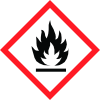
Icons in SDS
Company Information
company name
Diagenode SA
GHS Information
Signal word
Danger
Hazard Codes
Hazard statements (CLP)
H225, H314, H318, H336, H350
Hazard statements
Code
Statements
H225
Highly Flammable liquid and vapour
Section 2
OSHA HCS Classification
section
Hazard categories
category hazard state ment A.2 skin corrosion/irritation 1B Skin Corr. 1B H314 A.3 serious eye damage/eye irritation 1 Eye Dam. 1 H318 A.6 carcinogenicity 1A Carc. 1A H350 A.8D specific target organ toxicity - single exposure (narcotic ef- 3 STOT SE 3 H336 fects, drowsiness) B.6 flammable liquid 2 Flam. Liq. 2 H225 for full text of abbreviations: see SECTION 16.
Most important adverse effects
skin corrosion produces an irreversible damage to the skin; namely, visible necrosis through the epidermis and into the dermis. the product is combustible and can be ignited by potential ignition sources.
2.2 Label elements
labelling acc. to OSHA "Hazard Communication Standard" (29 CFR 1910.1200)
Signal word
danger
Hazard pictograms
GHS02, GHS05, GHS07, GHS08
Hazard statements
H225 highly flammable liquid and vapor. H314 causes severe skin burns and eye damage. H336 may cause drowsiness or dizziness. H350 may cause cancer.
Precautionary statements
P202 do not handle until all safety precautions have been read and understood. P210 keep away from heat/sparks/open flames/hot surfaces. No smoking. P240 ground/bond container and receiving equipment. P241 use explosion-proof electrical/ventilating/lighting equipment. P242 use only non-sparking tools. P243 take precautionary measures against static discharge. P260 do not breathe dusts or mists. P271 use only outdoors or in a well-ventilated area. P280 wear protective gloves/eye protection/face protection. P301+P330+P331 if swallowed: Rinse mouth. Do NOT induce vomiting. P303+P361+P353 if on skin (or hair): Take off immediately all contaminated clothing. Rinse skin with water/shower. P304+P340 if inhaled: Remove person to fresh air and keep comfortable for breathing. P305+P351+P338 if in eyes: Rinse cautiously with water for several minutes. Remove contact lenses, if present and easy to do. Continue rinsing. P310 immediately call a poison center/doctor. P321 specific treatment (see on this label). P363 wash contaminated clothing before reuse. P370+P378 in case of fire: Use sand, carbon dioxide or powder extinguisher to extinguish. P403+P233 store in a well-ventilated place. Keep container tightly closed. P403+P235 store in a well-ventilated place. Keep cool. P405 store locked up. P501 dispose of contents/container to industrial combustion plant.
Hazardous Ingredients
Ethanol, Propan-2-ol, Sodium hydroxide
Results of PBT and vPvB assessment
this mixture does not contain any substances that are assessed to be a PBT or a vPvB.



