




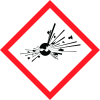
Note: Ingredients listed on restricted chemical lists
EC/CAS
204-289-6/118-96-7
Name of the chemical
2,4,6-Trinitrotoluol (und Isomeren in technischen Gemischen)
Concentration
100%
General Information
Version
GHS 1.0
Revision date
2019-03-08
Product name
2,4,6-trinitrotoluene
Product Synonyms
2,4,6-TNT, 2-methyl-1,3,5-trinitrobenzene
CAS No.
118-96-7
REACH No
this
Icons in SDS


Company Information
company name
Chemos GmbH & Co. KG
e-mail address of the competent person responsible for the Safety Data Sheet
chemos@chemos.de
GHS Information
Signal word
danger
Hazard Codes
Hazard statements (CLP)
H201, H301, H301+H311+H331, H311, H331, H373, H411
Hazard statements
Code
Statements
H201
Explosive; mass explosion hazard
Section 2
SECTION 2: Hazards identification
According to Regulation (EC) No 1272/2008 [CLP Classification of the substance or mixture
Hazard categories
Category Hazard class and cat- Hazard state- egory ment 2.1 explosive 1.1 Expl. 1.1 H201 3.1O acute toxicity (oral) Acute Tox. 3 H301 3.1D acute toxicity (dermal) Acute Tox. 3 H311 3.1I acute toxicity (inhal.) Acute Tox. 3 H331 3.9 specific target organ toxicity - repeated exposure STOT RE 2 H373 4.1C hazardous to the aquatic environment - chronic hazard Aquatic Chronic 2 H411 For full text of abbreviations: see SECTION 16
Most important adverse effects
Delayed or immediate effects can be expected after short or long-term exposure. Risk of explosion by shock, friction, fire or other sources of ignition. Spillage and fire water can cause pollution of watercourses
Signal word
danger
Hazard pictograms
GHS01, GHS06, GHS08, GHS09
Hazard statements
H201 Explosive; mass explosion hazard. H301+H311+H331 Toxic if swallowed, in contact with skin or if inhaled. H373 May cause damage to organs through prolonged or repeated exposure. H411 Toxic to aquatic life with long lasting effects.
Precautionary statements
P210 Keep away from heat, hot surfaces, sparks, open flames and other ignition sources. No smoking. P230 Keep wetted with water. P234 Keep only in original packaging. P250 Do not subject to grinding/shock/friction. P260 Do not breathe dust/fume/gas/mist/vapours/spray. P280 Wear protective gloves/protective clothing/eye protection/face protection. P301+P310 IF SWALLOWED: Immediately call a POISON CENTER/doctor. P370+P372+P380+P37 In case of fire: Explosion risk. Evacuate area. DO NOT fight fire when fire reaches explosives. 3 P403+P233 Store in a well-ventilated place. Keep container tightly closed.
Results of PBT and vPvB assessment
According to the results of its assessment, this substance is not a PBT or a vPvB.
2.1 Classification of the substance or mixture
Classification according to Regulation (EC) No 1272/2008 (CLP) Section Hazard class Category Hazard class and cat- Hazard state- egory ment 2.1 explosive 1.1 Expl. 1.1 H201 3.1O acute toxicity (oral) 3 Acute Tox. 3 H301 3.1D acute toxicity (dermal) 3 Acute Tox. 3 H311 3.1I acute toxicity (inhal.) 3 Acute Tox. 3 H331 3.9 specific target organ toxicity - repeated exposure 2 STOT RE 2 H373 4.1C hazardous to the aquatic environment - chronic hazard 2 Aquatic Chronic 2 H411 For full text of abbreviations: see SECTION 16. The most important adverse physicochemical, human health and environmental effects Delayed or immediate effects can be expected after short or long-term exposure. Risk of explosion by shock, friction, fire or other sources of ignition. Spillage and fire water can cause pollution of watercourses.


