



Note: Ingredients listed on restricted chemical lists
EC/CAS
203-625-9/108-88-3
Name of the chemical
Toluene
Concentration
100%
General Information
Version
GHS 2.0
Revision date
2023-08-22
Product name
Toluene
Product Synonyms
EGJ-0100-25A, 01.529.956
CAS No.
108-88-3
1.2.1 Relevant identified uses
Professional use
Emergency telephone
+44 (0) 7803 746 135 24, 0845 46 47
Icons in SDS


Company Information
company name
CellPath Ltd
e-mail address of the competent person responsible for the Safety Data Sheet
qhse@cellpath.co.uk
GHS Information
Signal word
danger
Hazard Codes
Hazard statements (CLP)
H225, H304, H315, H336, H361d, H373
Hazard statements
Code
Statements
H225
Highly Flammable liquid and vapour
Section 2
SECTION 2: Hazards identification
Classification of the substance or mixture Classification acc. to GHS Section Hazard class Category Hazard class and cat- Hazard state- egory ment flammable liquid 2 Flam. Liq. 2 H225 3.2 skin corrosion/irritation 2 Skin Irrit. 2 H315 3.7 reproductive toxicity 2 Repr. 2 H361d 3.8D specific target organ toxicity - single exposure (narcotic ef- 3 STOT SE 3 H336 fects, drowsiness) 3.9 specific target organ toxicity - repeated exposure 2 STOT RE 2 H373 3.10 aspiration hazard 1 Asp. Tox. 1 H304 For full text of abbreviations: see SECTION 16
Most important adverse effects
Delayed or immediate effects can be expected after short or long-term exposure. The product is combustible and can be ignited by potential ignition sources
Signal word
danger
Hazard pictograms
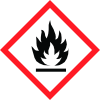
GHS02, GHS07, GHS08
Hazard statements
H225 Highly flammable liquid and vapour. H304 May be fatal if swallowed and enters airways. H315 Causes skin irritation. H336 May cause drowsiness or dizziness. H361d Suspected of damaging the unborn child. H373 May cause damage to organs through prolonged or repeated exposure.
Precautionary statements
P210 Keep away from heat, hot surfaces, sparks, open flames and other ignition sources. No smoking. P260 Do not breathe dust/fume/gas/mist/vapours/spray. P280 Wear protective gloves/protective clothing/eye protection/face protection/hearing protection/ …. P301+P310 IF SWALLOWED: Immediately call a POISON CENTER/doctor. P301+P330+P331 IF SWALLOWED: rinse mouth. Do NOT induce vomiting. P303+P361+P353 IF ON SKIN (or hair): Take off immediately all contaminated clothing. Rinse skin with water [or shower]. P308+P313 IF exposed or concerned: Get medical advice/attention. P331 Do NOT induce vomiting. P370+P378 In case of fire: Use sand, carbon dioxide or powder extinguisher to extinguish. P403+P233 Store in a well-ventilated place. Keep container tightly closed. P403+P235 Store in a well-ventilated place. Keep cool.
Results of PBT and vPvB assessment
According to the results of its assessment, this substance is not a PBT or a vPvB. Endocrine disrupting properties Does not contain an endocrine disruptor (EDC) in a concentration of ≥ 0,1%.
2.1 Classification of the substance or mixture
Classification acc. to GHS Section Hazard class Category Hazard class and cat- Hazard state- egory ment 2.6 flammable liquid 2 Flam. Liq. 2 H225 3.2 skin corrosion/irritation 2 Skin Irrit. 2 H315 3.7 reproductive toxicity 2 Repr. 2 H361d 3.8D specific target organ toxicity - single exposure (narcotic ef- 3 STOT SE 3 H336 fects, drowsiness) 3.9 specific target organ toxicity - repeated exposure 2 STOT RE 2 H373 3.10 aspiration hazard 1 Asp. Tox. 1 H304 For full text of abbreviations: see SECTION 16. The most important adverse physicochemical, human health and environmental effects Delayed or immediate effects can be expected after short or long-term exposure. The product is combustible and can be ignited by potential ignition sources.



