

Note: Ingredients listed on restricted chemical lists
EC/CAS
200-001-8/50-00-0
Name of the chemical
Formaldehyde
Concentration
25 - < 50
EC/CAS
200-659-6/67-56-1
Name of the chemical
Methanol
Concentration
603-001-
General Information
Version
GHS 10.0
Revision date
2024-08-13
Product name
Formaldehyde Solution 35/10
Product Synonyms
EGZ-0337-03A, EGZ-0337-25A, 00.088.402
CAS No.
50-00-0
1.2.1 Relevant identified uses
professional use
1.2.2. Uses advised against
Do not use for squirting or spraying. Do not use for products which come into direct contact with the skin
Emergency telephone
0845 46 47
Icons in SDS


Company Information
company name
CellPath Ltd
e-mail address of the competent person responsible for the Safety Data Sheet
qhse@cellpath.com
GHS Information
Signal word
danger
Hazard Codes
Hazard statements (CLP)
H301, H301+H311, H311, H314, H317, H318, H330, H335, H341, H350, H371
Hazard statements
Code
Statements
H301
Toxic if swallowed
Section 2
SECTION 2: Hazards identification
Classification of the substance or mixture Classification (acc. to GB CLP) Section
Hazard categories
Category Hazard class and cat- Hazard state- egory ment 3.1O acute toxicity (oral) Acute Tox. 3 H301 3.1D acute toxicity (dermal) Acute Tox. 3 H311 3.1I acute toxicity (inhal.) Acute Tox. 2 H330 3.2 skin corrosion/irritation 1B Skin Corr. 1B H314 3.3 serious eye damage/eye irritation Eye Dam. 1 H318 3.4S skin sensitisation Skin Sens. 1 H317 3.5 germ cell mutagenicity Muta. 2 H341 3.6 carcinogenicity 1B Carc. 1B H350 3.8 specific target organ toxicity - single exposure STOT SE 2 H371 Section Category Hazard class and cat- Hazard state- egory ment 3.8R specific target organ toxicity - single exposure (respiratory STOT SE 3 H335 tract irritation) For full text of abbreviations: see SECTION 16
Most important adverse effects
Skin corrosion produces an irreversible damage to the skin; namely, visible necrosis through the epidermis and into the dermis. Immediate effects can be expected after short-term exposure
2.2 Label elements
Labelling (acc. to GB CLP)
Signal word
danger
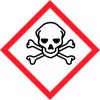
Hazard pictograms
GHS05, GHS06, GHS08
Hazard statements
H301+H311 Toxic if swallowed or in contact with skin. H314 Causes severe skin burns and eye damage. H317 May cause an allergic skin reaction. H330 Fatal if inhaled. H335 May cause respiratory irritation. H341 Suspected of causing genetic defects. H350 May cause cancer. H371 May cause damage to organs.
Precautionary statements
P260 Do not breathe dust/fume/gas/mist/vapours/spray. P280 Wear protective gloves/protective clothing/eye protection/face protection/hearing protec- tion/…. P301+P310 IF SWALLOWED: Immediately call a POISON CENTER/doctor/... P303+P361+P353 IF ON SKIN (or hair): Take off immediately all contaminated clothing. Rinse skin with water [or shower]. P304+P340 IF INHALED: Remove person to fresh air and keep comfortable for breathing. P305+P351+P338 IF IN EYES: Rinse cautiously with water for several minutes. Remove contact lenses, if present and easy to do. Continue rinsing. P403+P233 Store in a well-ventilated place. Keep container tightly closed.
Hazardous Ingredients
Formalin, Methanol
2.3 Other hazards
This material is combustible, but will not ignite readily.
Results of PBT and vPvB assessment
Does not contain a PBT-/vPvB-substance at a concentration of ≥ 0,1%. Endocrine disrupting properties Does not contain an endocrine disruptor (ED) at a concentration of ≥ 0,1%.
2.1 Classification of the substance or mixture
Classification (acc. to GB CLP) Section Hazard class Category Hazard class and cat- Hazard state- egory ment 3.1O acute toxicity (oral) 3 Acute Tox. 3 H301 3.1D acute toxicity (dermal) 3 Acute Tox. 3 H311 3.1I acute toxicity (inhal.) 2 Acute Tox. 2 H330 3.2 skin corrosion/irritation 1B Skin Corr. 1B H314 3.3 serious eye damage/eye irritation 1 Eye Dam. 1 H318 3.4S skin sensitisation 1 Skin Sens. 1 H317 3.5 germ cell mutagenicity 2 Muta. 2 H341 3.6 carcinogenicity 1B Carc. 1B H350 3.8 specific target organ toxicity - single exposure 2 STOT SE 2 H371 Section Hazard class Category Hazard class and cat- Hazard state- egory ment 3.8R specific target organ toxicity - single exposure (respiratory 3 STOT SE 3 H335 tract irritation) For full text of abbreviations: see SECTION 16. The most important adverse physicochemical, human health and environmental effects Skin corrosion produces an irreversible damage to the skin; namely, visible necrosis through the epidermis and into the dermis. Immediate effects can be expected after short-term exposure.



