

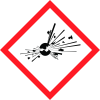


Note: Ingredients listed on restricted chemical lists
EC/CAS
55-63-0
Name of the chemical
Nitroglycerin; Propane-1,2,3-triyl trinitrate
Concentration
N/A
EC/CAS
6484-52-2
Name of the chemical
Ammonium Nitrate (AN)
Concentration
N/A
EC/CAS
200-240-8
Name of the chemical
Nitroglycerin; Propane-1,2,3-triyl trinitrate
Concentration
N/A
General Information
Product name
POLADYN 31 ECO
Substance name
Dynamite Explosive
1.2.1 Relevant identified uses
and rocks in conditions free of coal-dust and/or methane explosion risk
Manufacturer Name
NITROERG S.A
Emergency telephone
(24hr) Tel +44 (0) 7954 408 377
Icons in SDS
Company Information
company name
BREXCO
e-mail address of the competent person responsible for the Safety Data Sheet
office@brexco.co.uk
GHS Information
Signal word
Danger
Hazard Codes
Hazard statements (CLP)
H201, H300, H310, H330, H373, H412
Hazard statements
Code
Statements
H201
Explosive; mass explosion hazard
Section 2
SECTION 2: Hazards identification
Regulation (EC) No. 1272/2008 Classification of the mixture according to Directive 67/548/EEC E R 2 T+ R 26/27/28 R 33 R 52-53 2.1.2 Classification of the mixture according to Regulation (EC) No. 1272/2008 Expl. 1.1 H201 Acute Tox. 2 H330 Acute Tox. 1 H310 Acute Tox. 2 H300 STOT RE 2 H373 Aquatic Chronic 3 H412
2.2 Label elements
Below mentioned elements of marking are used only in transport of not elaborated explosive between operations. Note: In accordance with the Regulation of the Minister of Health of 5 March 2009 on the labelling of hazardous substances and hazardous preparations, packages with explosives are not labelled under that regulation but under the ADR regulations. This labelling is discussed in Section 14. According to EEC Directive 67/548 E – Explosive R 2 Risk of explosion by shock, friction, fire and/or other sources of energy. T+ – very toxic R 26/27/28 Very toxic by inhalation, in contact with skin and if swallowed. R 33 Danger of cumulative effects. R 52-53 Harmful to aquatic organisms; may cause long-term adverse effects in the aquatic environment. Safety advice concerning the mixture (S-phrases): S 1 – Keep locked up. S 20/21 – When using do not eat, drink or smoke. S 35 – This material and its container must be disposed of in a safe way. S 36 – Wear suitable protective clothing. S 41 – In case of fire and/or explosion do not breathe fumes. S 45 – In case of accident or if you feel unwell seek medical advice immediately (show the label where possible). According to Regulation (EC) No. 1272/2008 Expl. 1.1 H201 Explosive; Risk of massive explosion. Explosive subcategory 1.1 Acute Tox. 1 H310 Fatal in contact with skin. Acute toxicity dermal, category 1 Acute Tox. 2 H300 Fatal if swallowed. Acute toxicity oral and H330 Fatal if inhaled. inhalation, category 2 3 STOT RE 2 H373 May cause damage to circulatory system in the consequence of long-term Target organ toxicity - exposure or repeated exposure via inhalation or ingestion. repeated exposure, category 2 Aquatic Chronic 3 H412 Harmful to aquatic organisms, causes long-lasting effects. Poses hazard to aquatic life, category 3
Precautionary statements
P-phrases) P210: – Keep away from heat/sparks/open flames/hot surfaces. No smoking. P270: – Do not eat, drink, or smoke when using this product. P302+P352:– IF ON SKIN: Gently wash with plenty of soap and water. P370: – In case of fire: Do not breathe fume. P372: – Explosion risk in case of fire. P373: – DO NOT fight fire when fire reaches explosives. P312: – Call a POISON CENTRE or doctor/physician if you feel unwell. P501: – Dispose of contents/container (to) in a safe manner. P101: – If medical advice is needed, have product container or label at hand. 2.1. Threat with the explosion E – Explosives R 2 There is threat of explosion as a result of the impact, friction, the interaction of fire and other energy factors. Decomposition of the explosive occurs when the temperature exceeds 140°C. Very toxic oxides and nitrogen are produced during the heating and the incineration. 2.2. Remaining threats 2.2.1. Fire threat The burning of small quantities should take place safely in open spaces. Burning small or large quantities in confined and /or closed spaces are liable to detonate resulting in fire as a secondary effect. 2.2.2. Eco-toxic threat The product is insoluble in water; a threat of the pollution of ground does not occur.
2.3 Other hazards
The mixture is an explosive material decomposing at temperatures exceeding 165°C. Heating and combustion of the material yield highly toxic nitrogen oxides. The product burns gently if in small quantities and in the open air. Combustion of small quantities in enclosed space or combustion of large quantities turns into explosion. Fire may occur also as a secondary effect of detonation.



