

Note: Ingredients listed on restricted chemical lists
EC/CAS
7732-18-5
Name of the chemical
Water, distilled, conductivity or of similar purity H2O
Concentration
N/A
EC/CAS
1310-73-2
Name of the chemical
sodium hydroxide
Concentration
N/A
General Information
Revision date
2019-02-03
Product name
Solution A
Product Synonyms
Sodium Hydroxide 2% in distilled water
1.2.1 Relevant identified uses
For laboratory and manufacturing use only
1.2.2. Uses advised against
Not for food, drug or household use
supplier name
Biosensis Pty. Ltd.
Manufacturer Name
Biosensis Pty. Ltd
Emergency telephone
Telephone + 61 8 83527711; (800) 222-1222
Icons in SDS
Company Information
company name
Biosensis Pty. Ltd.
e-mail address of the competent person responsible for the Safety Data Sheet
sales@biosensis.com
GHS Information
Signal word
Danger
Hazard Codes
Hazard statements (CLP)
H314, H318, H402
Hazard statements
Code
Statements
H314
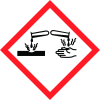
Causes severe skin burns and eye damage
Section 2
Classification (GHS-US)
Skin corrosion/irritation Category 1B H314 Causes severe skin burns and eye damage Serious eye damage/eye irritation Category 1 H318 Causes serious eye damage H314 Causes severe skin burns and eye damage H318 Causes serious eye damage H402 Harmful to aquatic life NFPA health hazard : 3 - Materials that, under emergency conditions, can cause serious or permanent injury. NFPA fire hazard : 0 - Materials that will not burn under typical fire conditions, including intrinsically noncombustible materials such as concrete, stone, and sand. NFPA reactivity : 1 - Materials that in themselves are normally stable but can become unstable at elevated temperatures and pressures.
Hazard statements
02-14-2019/MSDS FJ/LMF Rev 12 FOR RESEARCH USE ONLY 2 Health : 3 Serious Hazard - Major injury likely unless prompt action is taken and medical treatment is given Flammability : 0 Minimal Hazard - Materials that will not burn Physical : 1 Slight Hazard - Materials that are normally stable but can become unstable (self-react) at high temperatures and pressures. Materials may react non-violently with water or undergo hazardous polymerization in the absence of inhibitors. Personal protection : D D - Face shield and eye protection, Gloves, Synthetic apron H314 - Causes severe skin burns and eye damage
2.2 Label elements
GHS-US labeling
Signal word
Danger
Precautionary statements
P260 - Do not breathe mist, spray, vapors. P264 - Wash exposed skin thoroughly after handling. P280 - Wear eye protection, face protection, protective clothing, protective gloves. P301+P330+P331 - IF SWALLOWED: Rinse mouth. Do NOT induce vomiting. P303+P361+P353 - IF ON SKIN (or hair): Remove/Take off immediately all contaminated clothing. Rinse skin with water/shower. P305+P351+P338 - If in eyes: Rinse cautiously with water for several minutes. Remove contact lenses, if present and easy to do. Continue rinsing P310 - Immediately call a poison center or doctor/physician. P363 - Wash contaminated clothing before reuse. P405 - Store locked up. P501 - Dispose of contents/container to Comply with applicable regulations If inhaled: Remove person to fresh air and keep comfortable for breathing
Other hazards which do not result in classification
None.
Ingredient(s) with unknown acute toxicity
Not applicable 02-14-2019/MSDS FJ/LMF Rev 12 FOR RESEARCH USE ONLY 3



