



General Information
Product name
PERCHLORIC ACID
CAS No.
007601-90-3
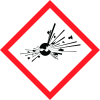
Icons in SDS
Company Information
company name
BIOCHEM CHEMOPHARAMA France
GHS Information
Signal word
Danger
Hazard Codes
Hazard statements (CLP)
H271, H314, H318
Hazard statements
Code
Statements
H271
May cause fire or explosion; strong oxidiser
Section 2
SECTION 2: Hazards identification
DSD Regulation EC 1272/2008 (CLP)]
2.1 Classification of the substance or mixture
EC 67/548 or EC 1999/45
Classifications
O; R8 R5 C; R35
Hazard categories
Code(s), Regulation (EC) No 1272/2008 (CLP)
Health hazards
Skin corrosion - Category 1A - Danger (CLP : Skin Corr. 1A) H314 Serious eye damage - Category 1 - Danger (CLP : Eye Dam. 1) H318
Physical hazards
Oxidizing liquids - Category 1 - Danger (CLP : Ox. Liq. 1) H271
2.2 Label elements
EC 67/548 or EC 1999/45 -DSD (continued) Regulation EC 1272/2008 (CLP)
Hazard pictograms
O : Oxidizing C : Corrosive
R-phrase(s)
R5 : Heating may cause an explosion. R8 : Contact with combustible material may cause fire. R35 : Causes severe burns.
S-phrase(s)
S1/2 : Keep locked up and out of reach of children. S23 : Do not breathe the gas, fumes, vapours, spray. S26 : In case of contact with eyes, rinse immediately with plenty of water and seek medical advice. S36 : Wear suitable protective clothing. S45 : In case of accident or if you feel unwell, seek medical advice immediately ( show the label when possible).
Signal word
Danger
Hazard statements
H271 : May cause fire or explosion; strong oxidizer. H314 : Causes severe skin burns and eye damage.
Precautionary statements
General : P102: Keep out of reach of children. P103: Read label before use. P101: If medical advice is needed, have product container or label at hand.
Prevention
P210: Keep away from heat, sparks, open flames or hot surfaces. – No smoking. P280: Wear protective gloves, protective clothing, eye protection, face protection. P260: Do not breathe dust, fume, gas, mist, vapours, spray. P220: Keep away from clothing - combustible materials. P264: Wash thoroughly after handling.
Response
P371+P380+P375 In case of major fire and large quantities Evacuate area. Fight fire remotely due to the risk of explosion. P301+P330+P331 IF SWALLOWED Rinse mouth. Do NOT induce vomiting P305+P351+P338 IF IN EYES Rinse cautiously with water for several minutes Remove contact lenses, if present and easy to do. Continue rinsing. P303+P361+P353 IF ON SKIN (or hair) Remove immediately all contaminated clothing. Rinse skin with water/shower. P306+P360 IF ON CLOTHING Rinse immediately contaminated clothing and skin with plenty of water before removing clothes. P363: Wash contaminated clothing before reuse. P370+P378 In case of fire Use for extinction -DSD (continued)
Storage
P405: Store locked up. • Disposal considerations : P501: Dispose of this material and its container to hazardous or special waste collection point, in accordance with local, regional, national and/or international regulation.
Other hazards
The substance does not fulfil the criteria to be identified as PBT substance or vPvB substance according to Annex XIII of Regulation REACH.


