


Note: Ingredients listed on restricted chemical lists
EC/CAS
424-610-5/120068-37-3
Name of the chemical
Fipronil; 5-Amino-1-[2,6-dichloro-4-(trifluoromethyl)phenyl]-4-[(trifluoromethyl)sulfinyl]-1H-pyrazole-3-carbonitrile
Concentration
N/A
EC/CAS
204-800-2/126-73-8
Name of the chemical
Tributyl phosphate
Concentration
N/A
EC/CAS
68412-54-4
Name of the chemical
Nonylphenolethoxylates (NPEO)
Concentration
N/A
General Information
Revision date
2013-07-12
Product name
TERMIDOR 25 EC
1.2.1 Relevant identified uses
crop protection product, insecticide
Icons in SDS

Company Information
company name
BASF SE
e-mail address of the competent person responsible for the Safety Data Sheet
Produktinformation-Pflanzenschutz@basf.com
GHS Information
Signal word
Danger
Hazard Codes
Hazard statements (CLP)
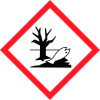
H304, H351, H373, H400, H410
Hazard statements
Code
Statements
H304
May be fatal if swallowed and enters airways
Section 2
2.1 Classification of the substance or mixture
According to Regulation (EC) No 1272/2008 [CLP] Asp. Tox. 1 Carc. 2 STOT RE (Central nervous system) 2 Aquatic Acute 1 Aquatic Chronic 1 According to Directive 67/548/EEC or 1999/45/EC Carc. Cat. 3 Irritating to skin. Limited evidence of a carcinogenic effect. Harmful: danger of serious damage to health by prolonged exposure if swallowed. Harmful: may cause lung damage if swallowed. Very toxic to aquatic organisms, may cause long-term adverse effects in the aquatic environment. For the classifications not written out in full in this section the full text can be found in section 16.
2.2 Label elements
Globally Harmonized System, EU (GHS)
Signal word
Danger
Hazard statements
H304 May be fatal if swallowed and enters airways. H351 Suspected of causing cancer. H373 May cause damage to organs (peripheral nervous system) through prolonged or repeated exposure. H400 Very toxic to aquatic life. H410 Very toxic to aquatic life with long lasting effects. EUH401 To avoid risks to human health and the environment, comply with the instructions for use.
Prevention
P201 Obtain special instructions before use. P260d Do not breathe vapours. P281 Use personal protective equipment as required.
Response
P301 + P310 IF SWALLOWED: Immediately call a POISON CENTER or doctor/physician. P308 + P313 IF exposed or concerned: Get medical advice/attention. P314 Get medical advice/attention if you feel unwell. P331 Do NOT induce vomiting. P391 Collect spillage.
Storage
P405 Store locked up.
Precautionary statements
Disposal) P501 Dispose of contents/container to hazardous or special waste collection point. According to Regulation (EC) No 1272/2008 [CLP] Hazard determining component(s) for labelling: FIPRONIL, TRIBUTYLPHOSPHATE, KEROSENE (PETROLEUM) According to Directive 67/548/EEC or 1999/45/EC EEC Directives Hazard symbol(s) Xn Harmful. N Dangerous for the environment.
R-phrase(s)
R38 Irritating to skin. R40 Limited evidence of a carcinogenic effect. R48/22 Harmful: danger of serious damage to health by prolonged exposure if swallowed. R65 Harmful: may cause lung damage if swallowed. R50/53 Very toxic to aquatic organisms, may cause long-term adverse effects in the aquatic environment.
S-phrase(s)
S2 Keep out of the reach of children. S13 Keep away from food, drink and animal feeding stuffs. S20/21 When using do not eat, drink or smoke. S29/35 Do not empty into drains, this material and its container must be disposed of in a safe way. S36/37 Wear suitable protective clothing and gloves. S46 If swallowed, seek medical advice immediately and show this container or label. S57 Use appropriate container to avoid environmental contamination. Hazard determining component(s) for labelling: FIPRONIL, TRIBUTYLPHOSPHATE, KEROSENE (PETROLEUM)
2.3 Other hazards
According to Regulation (EC) No 1272/2008 [CLP] See section 12 - Results of PBT and vPvB assessment. If applicable information is provided in this section on other hazards which do not result in classification but which may contribute to the overall hazards of the substance or mixture.



