

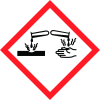

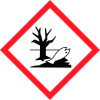
General Information
Revision date
2022-01-02
Product name
Rylox
1.2.1 Relevant identified uses
crop protection product, fungicide
Emergency telephone
+49 180 2273-112
Icons in SDS


Company Information
company name
BASF SE
e-mail address of the competent person responsible for the Safety Data Sheet
product-safety-north@basf.com
GHS Information
Signal word
Danger
Hazard Codes
Hazard statements (CLP)
H302, H315, H317, H318, H332, H335, H410
Hazard statements
Code
Statements
H302
Harmful if swallowed
Section 2
2.1 Classification of the substance or mixture
For the classification of the mixture the following methods have been applied: extrapolation on the concentration levels of the hazardous substances, on basis of test results and after evaluation of experts. The methodologies used are mentioned at the respective test results. According to GB-CLP Regulations UK SI 2019/720 and UK SI 2020/1567 Acute Tox. 4 (oral) H302 Harmful if swallowed. Skin Corr./Irrit. 2 H315 Causes skin irritation. Skin Sens. 1 H317 May cause an allergic skin reaction. Eye Dam./Irrit. 1 H318 Causes serious eye damage. Acute Tox. 4 (Inhalation - mist) H332 Harmful if inhaled. STOT SE 3 H335 May cause respiratory irritation. Aquatic Chronic 1 H410 Very toxic to aquatic life with long lasting effects. For the classifications not written out in full in this section the full text can be found in section 16.
2.2 Label elements
Globally Harmonized System (GHS) in accordance with UK regulations.
Signal word
Danger
Hazard statements
H302 Harmful if swallowed. H315 Causes skin irritation. H317 May cause an allergic skin reaction. H318 Causes serious eye damage. H332 Harmful if inhaled. H335 May cause respiratory irritation. H410 Very toxic to aquatic life with long lasting effects.
Precautionary statements
P101 If medical advice is needed, have product container or label at hand. P102 Keep out of reach of children. P103 Read carefully and follow all instructions. (Disposal) P501 Dispose of contents/container to a licensed hazardous-waste disposal contractor or collection site except for empty clean containers which can be disposed of as non-hazardous waste. Labeling of special preparations (GHS): May produce an allergic reaction. According to GB-CLP Regulations UK SI 2019/720 and UK SI 2020/1567 Hazard determining component(s) for labelling: 1H-1,2,4-Triazole-1-ethanol, α-[4-(4-chlorophenoxy)- 2-(trifluoromethyl)phenyl]-α-methyl-, pyraclostrobin (ISO); methyl N-{2-[1-(4-chlorophenyl)-1H- pyrazol-3-yloxymethyl]phenyl}(N-methoxy)carbamate, N,N-Dimethyldecan-1-amide
Prevention
P261 Avoid breathing mist/vapours/spray. P264 Wash contaminated body parts thoroughly after handling. P270 Do not eat, drink or smoke when using this product. P271 Use only outdoors or in a well-ventilated area. P272 Contaminated work clothing should not be allowed out of the workplace. P273 Avoid release to the environment. P280 Wear protective gloves and eye protection/face protection
Response
P301 + P312 IF SWALLOWED: Call a POISON CENTER or doctor/physician if you feel unwell. P308 + P311 IF exposed or concerned: Call a POISON CENTER or physician. P330 Rinse mouth P305 + P351 + P338 IF IN EYES: Rinse cautiously with water for several minutes. Remove contact lenses, if present and easy to do. Continue rinsing. P310 Immediately call a POISON CENTER or physician. P312 Call a POISON CENTER or physician if you feel unwell. P304 + P340 IF INHALED: Remove person to fresh air and keep comfortable for breathing. P303 + P352 IF ON SKIN (or hair): Wash with plenty of soap and water. P333 + P313 If skin irritation or rash occurs: Get medical attention. P362 + P364 Take off contaminated clothing and wash it before reuse. P391 Collect spillage.
Storage
P403 + P233 Store in a well-ventilated place. Keep container tightly closed. P405 Store locked up.
2.3 Other hazards
According to GB-CLP Regulations UK SI 2019/720 and UK SI 2020/1567 See section 12 - Results of PBT and vPvB assessment. If applicable information is provided in this section on other hazards which do not result in classification but which may contribute to the overall hazards of the substance or mixture.



