



Note: Ingredients listed on restricted chemical lists
EC/CAS
10042-76-9
Name of the chemical
Strontium nitrate
Concentration
≥60-≤75
General Information
Revision date
2025-03-27
Product name
05, 10, & 20 SLOW SET POWER CHARGE
1.2.1 Relevant identified uses
Slow Set Power Charge
supplier name
Baker Hughes, Australia
Emergency telephone
+61 8 6595 7100, +(65)-31581349, 001-803-017-9114, +(61) 2 9037 2994, 00-308-13-2549, +(84)-838012436, +(44) 870-820-0418, +(1) 703-527-3887
Icons in SDS


Company Information
company name
Baker Hughes, Australia
GHS Information
Signal word
DANGER
Hazard Codes
Hazard statements (CLP)
H204, H315, H317, H318, H334, H340, H351, H373, H412
Hazard statements
Code
Statements
H204
Fire or projection hazard
Section 2
SECTION 2: Hazards identification
Classification of the substance or mixture EXPLOSIVES - Division 1.4 SKIN CORROSION/IRRITATION - Category 2 SERIOUS EYE DAMAGE/EYE IRRITATION - Category 1 RESPIRATORY SENSITISATION - Category 1 SKIN SENSITISATION - Category 1 GERM CELL MUTAGENICITY - Category 1 CARCINOGENICITY - Category 2 SPECIFIC TARGET ORGAN TOXICITY - REPEATED EXPOSURE - Category 2 LONG-TERM (CHRONIC) AQUATIC HAZARD - Category 3
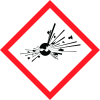
Hazard pictograms
GHS01 GHS05 GHS08
Signal word
DANGER
Hazard statements
H204 - Fire or projection hazard. H315 - Causes skin irritation. H317 - May cause an allergic skin reaction. H318 - Causes serious eye damage. H334 - May cause allergy or asthma symptoms or breathing difficulties if inhaled. H340 - May cause genetic defects. H351 - Suspected of causing cancer. H373 - May cause damage to organs through prolonged or repeated exposure. H412 - Harmful to aquatic life with long lasting effects.
Prevention
Obtain special instructions before use. Wear protective gloves, protective clothing and eye or face protection. Wear respiratory protection. Keep away from heat, hot surfaces, sparks, open flames and other ignition sources. No smoking. Keep only in original packaging. Avoid release to the environment. Do not breathe dust. Wash thoroughly after handling.
Response
In case of fire: Explosion risk. Evacuate area. DO NOT fight fire when fire reaches explosives. IF exposed or concerned: Get medical advice or attention. IF INHALED: Remove person to fresh air and keep comfortable for breathing. If experiencing respiratory symptoms: Call a POISON CENTER or doctor. Take off contaminated clothing and wash it before reuse. IF ON SKIN: Wash with plenty of water. If skin irritation or rash occurs Get medical advice or attention. IF IN EYES Rinse cautiously with water for several minutes. Remove contact lenses, if present and easy to do. Continue rinsing. Immediately call a POISON CENTER or doctor.
Storage
Store in accordance with all local, regional, national and international regulations.
Disposal
Dispose of contents and container in accordance with all local, regional, national and international regulations.
Precautionary statements
-, P201, P280, P284, P210, P234, P273, P260, P264, P370 + P372 + P380 + P373, (Code) P308 + P313, P304 + P340, P342 + P311, P362 + P364, P302 + P352, P333 + P313, P305 + P351 + P338, P310, P401, P501, P503
Supplemental label elements
Not applicable.
Other hazards which do not result in classification
None known.
Additional information
Mixing of chemicals may create a reaction hazardous to one’s health, to the environment, or a potential fire hazard.
2.1 Classification of the substance or mixture
EXPLOSIVES - Division 1.4 substance or mixture SKIN CORROSION/IRRITATION - Category 2 SERIOUS EYE DAMAGE/EYE IRRITATION - Category 1 RESPIRATORY SENSITISATION - Category 1 SKIN SENSITISATION - Category 1 GERM CELL MUTAGENICITY - Category 1 CARCINOGENICITY - Category 2 SPECIFIC TARGET ORGAN TOXICITY - REPEATED EXPOSURE - Category 2 LONG-TERM (CHRONIC) AQUATIC HAZARD - Category 3


