




Note: Ingredients listed on restricted chemical lists
EC/CAS
78-11-5
Name of the chemical
Pentaerithrityl tetranitrate (INN)
Concentration
N/A
General Information
Revision date
2015-08-01
Product name
and Synonyms Lite Line, Scotch Cord, A-Cord, No. 10 through No. 400 cord series, Seismic Detonating Cord, Slide Line Series, Special Series Detonating Cords, Cordeau detonant fuse
CAS No.
78-11-5
1.2.1 Relevant identified uses
As a commercial explosive
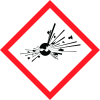
Icons in SDS
Company Information
company name
Austin Powder Company
GHS Information
Signal word
Danger
Hazard Codes
Hazard statements (CLP)
H201, H302, H311, H331, H370, H373
Hazard statements
Code
Statements
H201
Explosive; mass explosion hazard
H302
Harmful if swallowed
H311
Toxic in contact with skin
H331
Toxic if inhaled
H370
Causes damage to organs
H373
May cause damage to organs through prolonged or repeated exposure
Section 2
Physical hazards
H201 – May mass explode in a fire, Division 1.1
Health hazards
H302 – Toxic if swallowed, acute toxicity, Hazard Category 4 H311 – Toxic in contact with skin, acute toxicity, Hazard Category 3 H331 – Toxic if inhaled, acute toxicity, Hazard Category 3 H370 – May cause damage to organs, Specific Target Organ Toxicity, single exposure, Hazard Category 1 H373 – May cause damage to organs through prolonged or repeated exposure, Specific Target Organ Toxicity, repeated exposure, Hazard Category 2
Signal word
Danger
Precautionary statements
P210 – Keep away from heat, hot surfaces, sparks, open flames and other ignition sources. No smoking. P250 – Do not subject to grinding, friction, impact or shock. P260 – Do not breathe dust or fumes. P270 – Do not eat, drink or smoke when using this product. P273 – Avoid release to the environment. P280 – Wear eye protection, protective gloves recommended. P308+P313+P314 – If exposed or concerned or you do not feel well: Get medical attention. P370+P372+P373 – In case of fire: Extreme risk of explosion. Evacuate area. DO NOT fight fire when fire reaches explosives. P401+P403+P405 – Store locked-up in a ventilated space, in accordance with all applicable regulations. P501 – Dispose of contents/container in accordance with all applicable regulations.
2.3 Other hazards
Exposure reaction may be aggravated for those with pre-existing eye, skin, or respiratory conditions. Causes methemoglobinemia. Methemoglobinemia decreases the blood’s ability to carry oxygen and results in symptoms such as dizziness, drowsiness, headache, shortness of breath, blue skin and lips, rapid heart rate, unconsciousness, and possibly death.
Ingredient(s) with unknown acute toxicity
Not available


