



General Information
Revision date
2020-09-21
Product name
RDX
CAS No.
121-82-4
1.2.1 Relevant identified uses
Raw material for the manufacture of other explosives or pyrotechnic devices
1.2.2. Uses advised against
No further relevant information available
Emergency telephone
+54 3492 424775 – 0800 666 2282 (CIPET
Icons in SDS
Company Information
company name
Austin Powder Argentina S.A
e-mail address of the competent person responsible for the Safety Data Sheet
apa.comercial@austinpowder.com
GHS Information
Signal word
Danger
Hazard Codes
Hazard statements (CLP)
H201, H301, H372, H401, H402
Hazard statements
Code
Statements
H201
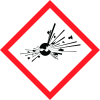
Explosive; mass explosion hazard
Section 2
Classification according to GHS
Rev.5)
Hazard categories
Code Expl. 1.1 H201 Division 1.1 Oral acute toxicity H301 3 Acute aquatic H401 2 Danger Systemic specific H372 1 repeated exposure Human and environmental-specific hazards: Substances and goods that present a risk of mass explosion.
2.2 Label elements
The product must be labelled according to the established regulations listed in the “Globally Harmonized System of Classification and Labelling of Chemical Products”, according to resolution 801/15 of the Labour Risks Superintendency (SRT).
Hazard pictograms
GHS01 GHS06 GHS08
Signal word
Danger
Hazard statements
H201 Explosive; mass explosion hazard. H301 Toxic if swallowed. H372 Causes damage to organs (liver) after prolonged or repeated exposures H402 Harmful for aquatic organisms.
Precautionary statements
P210 Keep away from heat/sparks/open flames/hot surfaces. - No smoking. P230 Keep humidified with greater than 25% humidity P234 Keep only in the original packaging. P240 Container and receiving equipment earthing and equipotential link. P250 Do not subject to grinding/shock/friction. P260 Do not breathe dust/fumes/gas/mist/vapor/spray P264 Wash hands carefully after handling P270 Do not eat, drink or smoke while handling this product P273 Do not spread in the environment P280 Wear protective gloves/protective clothing/eye protection/face protection.
2.3 Other hazards
Non- applicable SECTION 3: Hazards identification


