




Note: Ingredients listed on restricted chemical lists
EC/CAS
1309-60-0
Name of the chemical
Lead peroxide
Concentration
N/A
EC/CAS
13424-46-9
Name of the chemical
Bleiazid
Concentration
N/A
EC/CAS
236-542-1
Name of the chemical
Bleiazid
Concentration
N/A
EC/CAS
215-174-5
Name of the chemical
Lead dioxide
Concentration
N/A
General Information
Revision date
2017-05-31
Product name
Electric detonator
Emergency telephone
Comment
Icons in SDS
Company Information
company name
AUSTIN DETONATOR s.r.o
e-mail address of the competent person responsible for the Safety Data Sheet
msds@austin.cz
GHS Information
Signal word
Danger
Hazard Codes
Hazard statements (CLP)
H201, H302, H360Df, H370, H373, H411
Hazard statements
Code
Statements
H201
Explosive; mass explosion hazard
Section 2
CLP CLASSIFICATION
Explosives, Division 1.1 H201 Acute toxicity (oral), Category 4 H302 Reproductive toxicity, Category 1A H360Df Specific target organ toxicity — single exposure, Category 1 H370 Specific target organ toxicity — Repeated exposure, Category 2 H373 Hazardous to the aquatic environment — Chronic Hazard, Category 2 H411
Hazard statements
see section 16 : H201 - Explosive; mass explosion hazard. H302 - Harmful if swallowed. H360Df - May damage the unborn child. Suspected of damaging fertility. H370 - Causes damage to organs. H373 - May cause damage to organs through prolonged or repeated exposure. H411 - Toxic to aquatic life with long lasting effects.
Adverse physicochemical, human health and environmental effects
No additional information available
2.2 Label elements
Labelling according to Regulation (EC) No. 1272/2008 [CLP] Extra labelling to displayExtra classification(s) to display
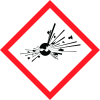
Hazard pictograms
GHS01 GHS07 GHS08 GHS09
Signal word
Danger
Hazardous Ingredients
Hexahydro-1,3,5-trinitro-1,3,5-triazin (RDX); lead diazide, lead azide; Lead dioxide
Precautionary statements
P201 - Obtain special instructions before use. P210 - Keep away from heat, hot surfaces, open flames, sparks. No smoking. P250 - Do not subject to friction, grinding, shock. P308+P313 - IF exposed or concerned: Get medical advice/attention. P370+P380 - In case of fire: evacuate area. P372 - Explosion risk in case of fire. P401 - Store in dry and well ventilated areas, in temperatures -30 °C to +40 °C. P501 - Dispose of contents/container must be in accordance with corresponding local regulations for disposal of packages and explosives.
Additional information
Explosives, as referred to in section 2.1 of Regulation (EC) No. 1272/2008, placed on the market with a view to obtaining an explosive or pyrotechnic effect shall be labelled and packaged in accordance with the requirements for explosives only.
Other hazards which do not result in classification
The mixture doesn’t meet the criteria for classification as PBT or vPvB substances and mixtures.
Other physicochemical hazards
Risk of explosion, an uncontrolled explosion may cause great physical damage. In the assembled detonator, the hazardous substances are enclosed in a metal case that cannot be disassembled. These substances can be released only by detonation in the form of post-detonation reaction products.


