


Note: Ingredients listed on restricted chemical lists
EC/CAS
78-11-5
Name of the chemical
Pentaerithrityl tetranitrate (INN)
Concentration
1-5
EC/CAS
13424-46-9
Name of the chemical
Bleiazid
Concentration
0.1-1
EC/CAS
25721-38-4
Name of the chemical
Lead picrate
Concentration
<0.1
EC/CAS
1309-60-0
Name of the chemical
Lead peroxide
Concentration
<0.1
EC/CAS
9004-70-0
Name of the chemical
Nitrocellulose
Concentration
<0.1
General Information
Revision date
2023-08-15
Product name
i-kon II; eDev II; Oseis; UNI Tronic 600; i-kon III; i-kon Plug-in; and i-kon W Electronic Detonators, in 1.1Bconfiguration
Emergency telephone
1-877-561-3636, 1-800-424-9300, 1-800-800-3855, 1-877- 561-3636
Icons in SDS


Company Information
company name
Canada
e-mail address of the competent person responsible for the Safety Data Sheet
sds.na@orica.com
GHS Information
Signal word
Danger
Hazard Codes
Hazard statements (CLP)
H350, H360, H373, H402, H412
Hazard statements
Code
Statements
H350
May cause cancer
H360
May damage fertility or the unborn child
H373
May cause damage to organs through prolonged or repeated exposure
H402
Harmful to aquatic life
H412
Harmful to aquatic life with long lasting effects
Section 2
SECTION 2: Hazards identification
Classification of the Substance or Mixture GHS-CA Classification PHNOC 1 Carc. 1 H350 Repr. 1 H360 STOT RE 2 H373 Aquatic Acute 3 H402 Aquatic Chronic 3 H412
Hazard statements
see section 16 : H350 - May cause cancer. H360 - May damage fertility or the unborn child. H373 - May cause damage to organs through prolonged or repeated exposure. H402 - Harmful to aquatic life. H412 - Harmful to aquatic life with long lasting effects. May cause an explosion through a vigorous reaction of decomposition.
2.2 Label elements
GHS-CA Labeling
Hazard pictograms
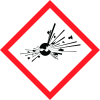
GHS01 GHS08
Signal word
Danger
Precautionary statements
P201 - Obtain special instructions before use. P202 - Do not handle until all safety precautions have been read and understood. P210 - Keep away from heat, hot surfaces, sparks, open flames and other ignition sources. No smoking. P240 - Ground/bond container and receiving equipment. P250 - Do not subject to grinding/shock/friction. P260 - Do not breathe vapors, mist, or spray. P273 - Avoid release to the environment. P280 - Wear protective gloves, protective clothing, and eye protection. P308+P313 - If exposed or concerned: Get medical advice/attention. P314 - Get medical advice/attention if you feel unwell. P370+P380 - In case of fire: Evacuate area. P372 - Explosion risk in case of fire. P373 - DO NOT fight fire when fire reaches explosives. P401 - Store in accordance with as defined in the Explosives Act of Canada and the provisions of the Bureau of Alcohol, Tobacco and Firearms regulations contained in 27 CFR P405 - Store locked up. P501 - Dispose of contents/container in accordance with as defined in the Explosives Act of Canada and the provisions of the Bureau of Alcohol, Tobacco and Firearms regulations contained in 27 CFR part 555.
Other hazards
Exposure may aggravate pre-existing eye, skin, or respiratory conditions. Ingestion may cause methemoglobinemia. Initial manifestation of methemoglobinemia is cyanosis, characterized by navy lips, tongue and mucous membranes, with skin color being slate grey. Further manifestation is characterized by headache, weakness, dyspnea, dizziness, stupor, respiratory distress and death due to anoxia. If ingested, nitrates may be reduced to nitrites by bacteria in the digestive tract. Signs and symptoms of nitrite poisoning include methemoglobinemia, nausea, dizziness, increased heart rate, hypotension, fainting and, possibly shock
Ingredient(s) with unknown acute toxicity
Not available
2.1 Classification of the substance or mixture
H350 Repr. 1 H360 STOT RE 2 H373 Aquatic Acute 3 H402 Aquatic Chronic 3 H412 Full text of hazard classes and H-statements : see section 16 Label Elements GHS-CA Labeling


