



Note: Ingredients listed on restricted chemical lists
EC/CAS
7439-92-1
Name of the chemical
Blei, massiv: [Partikeldurchmesser ≥ 1 mm]
Concentration
0.1-50
EC/CAS
78-11-5
Name of the chemical
Pentaerithrityl tetranitrate (INN)
Concentration
0.02-4
EC/CAS
1314-41-6
Name of the chemical
Orange lead (lead tetroxide)
Concentration
0.001-1.6
EC/CAS
13424-46-9
Name of the chemical
Bleiazid
Concentration
0.01-0.7
EC/CAS
7429-90-5
Name of the chemical
Aluminium
Concentration
0.006-0.02
General Information
Revision date
2018-12-20
Product name
Detonator Assemblies, Non-Electric
Product Synonyms
ExelTM HandidetTM 1.1B; ExelTM HandidetTM 1.4B; ExelTM HandidetTM LP 1.1B; ExelTM LP 1.1B; ExelTM LP 1.4B; ExelTM LP White 1.1B; ExelTM MS 1.1B; ExelTM MS 1.4B; ExelTM MS Connectors 1.1B; ExelTM MS Connectors 1.4B; ExelTM MS White 1.4B; ExelTM MSC-SP - 1.1B; ExelTM Noiseless Lead-in Line 1.4S; ExelTM SHD - 1.1B; ExelTM T&D - 1.1B; ExelTM T&D - 1.4B;
Emergency telephone
1-877-561-3636, 1-800-424-9300, 1-800-800-3855, 1-877- 561-3636
Icons in SDS


Company Information
company name
Canada
e-mail address of the competent person responsible for the Safety Data Sheet
sds.na@orica.com
GHS Information
Signal word
Danger
Hazard Codes
Hazard statements (CLP)
H350, H360, H362, H372, H400, H410
Hazard statements
Code
Statements
H350
May cause cancer
Section 2
SECTION 2: Hazards identification
Classification of the Substance or Mixture GHS-CA Classification PHNOC 1 Carc. 1B H350 Lact H362 Repr. 1A H360 STOT RE 1 H372 Aquatic Acute 1 H400 Aquatic Chronic 1 H410
Hazard statements
see section 16 : H350 - May cause cancer. H360 - May damage fertility or the unborn child. H362 - May cause harm to breast-fed children. H372 - Causes damage to organs (central nervous system, blood and kidneys) through prolonged or repeated exposure (Inhalation, oral). May cause an explosion through a vigorous reaction of decomposition. H400 - Very toxic to aquatic life. H410 - Very toxic to aquatic life with long lasting effects.
2.2 Label elements
GHS-CA Labeling
Hazard pictograms
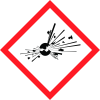
GHS01 GHS08 GHS09
Signal word
Danger
Precautionary statements
P201 - Obtain special instructions before use. P202 - Do not handle until all safety precautions have been read and understood. P210 - Keep away from heat, hot surfaces, open flames, sparks. - No smoking. P230 - Keep wetted with appropriate material. P240 - Ground/Bond container and receiving equipment. P250 - Do not subject to friction, grinding, shock. P260 - Do not breathe dust. P263 - Avoid contact during pregnancy/while nursing. P264 - Wash hands, forearms, and exposed areas thoroughly after handling. P270 - Do not eat, drink or smoke when using this product. P273 - Avoid release to the environment. P280 - Wear eye protection, protective gloves, protective clothing. P308+P313 - If exposed or concerned: Get medical advice/attention. P314 - Get medical advice/attention if you feel unwell. P370+P380 - In case of fire: Evacuate area. P372 - Explosion risk in case of fire. P373 - DO NOT fight fire when fire reaches explosives. P391 - Collect spillage. P401 - Store in accordance with as defined in Explosives Act of Canada. P405 - Store locked up. P501 - Dispose of contents/container in accordance with as defined in the Explosives Act of Canada.
Other hazards
Exposure may aggravate pre-existing eye, skin, or respiratory conditions
Ingredient(s) with unknown acute toxicity
Not available
2.1 Classification of the substance or mixture
GHS-CA Classification PHNOC 1 Carc. 1B H350 Lact H362 Repr. 1A H360 STOT RE 1 H372 Aquatic Acute 1 H400 Aquatic Chronic 1 H410 Full text of hazard classes and H-statements : see section 16



