

General Information
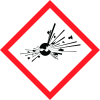
Icons in SDS

Company Information
company name
and listing possible waste codes
GHS Information
Signal word
Danger
Hazard Codes
Hazard statements (CLP)
H200, H201
Hazard statements
Code
Statements
H200
Unstable Explosive
Section 2
Hazard statements
are linked to a hazard class that relates back Hazardous Properties as laid out in Commission Regulation (EU) No 1357/2014,4 e.g. HP1 is linked to H200, H201, via the hazard class Unst. Expl. and Expl. 1.1 etc. Once hazard statements have been identified in Step 2, this allows identification of the hazardous properties they are linked to, for consideration in all subsequent steps. The CLP database maintained by the European Chemical Agency (ECHA) contains data relating to: \ Harmonised substances from Table 3.1 of the CLP5 (as amended by Adaptations to Technical Progress) and \ Classifications of other substances notified to the European Chemical Agency. This is available at: http://echa.europa.eu/web/guest/information-on-chemicals/cl-inventory-database If the substance is not contained in the above database, the holder must determine what hazard classes or categories, if any, it could fall into. Additional sources of information include REACH compliant Safety Data Sheets (SDSs). SDSs must be European, REACH/CLP compliant and with no significant or relevant gaps in the data, particularly hazardous properties that have not been addressed which could possibly affect the waste classification, i.e. missing data “Not fully tested” under the relevant hazardous property, i.e. HP14 or HP3. Step 3 – Does the waste display HP1–HP15? 3.1 Assessment of Hazardous Properties with Concentration Limits Concentration limits have been assigned for the hazardous properties HP4, HP5, HP6, HP7, HP8, HP10, HP11, HP13 and HP14. The waste is hazardous if the concentration limits are equalled or exceeded. All other entries in the harmonised LoW are considered non-hazardous. In some situations, the assessment is based on the sum concentration of all relevant substances6, i.e. the assessment is additive (e.g. for HP4, HP5, HP6 and HP8). In other cases, assessment is based on comparison of the concentration of each relevant substance individually against the concentration limit (i.e. for HP 7, HP 10 and HP 11). If Step 3.1 provides a cut-off value, the substances present below the cut-off value specified are not included in the sum of the concentrations for the hazard statement code that the cut-off value applies to. Hazard statements are assigned to a hazard class and category that describes the nature of a hazardous substance or mixture, including, where appropriate, the degree of hazard. This supersedes the risk phrases (R Phrases) that were used in the previous waste classification system except currently for the hazardous property HP14. Of 18 December 2014, replacing Annex III to Directive 2008/98/EC of the European Parliament and of the Council on waste and repealing certain Directives. Regulation [EC] No 1272/2008 of the European Parliament and of the Council of 16 December 2008 on classification, labelling and packaging of substances and mixtures, amending and repealing Directives 67/548/EEC and 1999/45/EC, and amending Regulation [EC] No 1907/2006. [Referred to as the Classification, Labelling and Packaging of Substances Regulation. Note that there are a significant number of amendments to this regulation [Adaptations to Technical Progress] as per the Eurolex website.] Relevant substances means substances with the hazardous property under consideration. 36 3.2 Assessment of Hazardous Properties without Concentration Limits Concentration limits have not been assigned for hazardous properties, HP1, HP2, HP3, HP9, HP12 and HP15. If your waste has a substance with any of these hazardous properties, the waste is classified as hazardous, unless property testing is done and demonstrates that the waste is non-hazardous. Evidence in this regard should be included in the classification report. Without such testing, however, the waste remains hazardous7. Step 4 – Does the waste contain POPs as outlined in Regulation (EC) NO 850/2004 (as amended) above the specified concentration? Wastes containing persistent organic pollutants (POPs) consisting of polychlorinated dibenzo- p-dioxins and dibenzofurans (PCDD/PCDF), DDT (1,1,1-trichloro-2,2- bis (4-chlorophenyl) ethane), chlordane, hexachlorocyclohexanes (including lindane), dieldrin, endrin, heptachlor, hexachlorobenzene, chlordecone, aldrine, pentachlorobenzene, mirex, toxaphene hexabromobiphenyl and/or PCB exceeding the concentration limits indicated in Annex IV to Regulation (EC) No 850/2004 of the European Parliament and of the Council shall be classified as hazardous. Wastes containing other POPs (for example endosulfan, hexachlorobutadiene, polychlorinated naphthalenes, SCCPs, PFOS, the POP-BDEs and HCBD) shall be assessed against the POPs Regulation and the hazardous properties in accordance with the procedures described in Step 3. Step 5 – List of Waste Entry After completion of Steps 1 to 4 , an appropriate hazardous or non-hazardous entry from the List of Wastes shall be assigned to the waste and the entered into the table in Step 5. Commission Decision of 18 December 2014 amending Decision 2000/532/EC on the list of waste pursuant to Directive 2008/98/ EC of the European Parliament and of the Council [2014/955/EU]. 37 Assessment Template Company details Company Name Company Address Date IED, IPC or Waste Licence Number (if applicable) Contact Person Contact Number Assessment Date Assessment based on partial composition, (Yes/No) (if Yes, provide the necessary evidence) List of Waste Entries List of Waste Entry Asterisk Yes No 38 Hazardous property of Source data assigning codes for Flashpoint (ºC) (HP3) Code(s)/ Code Hazard Statement Hazard Supplemental Code(s) Hazard CEN Method / No) Assigning Test approved (Yes & Details Test method % (w/w) Results Composition Test mg/kg Waste 2 & 1 Steps Substance 39 to mm2/s only kinetic does concentration exceed equal overall 40oC) 20.5 (yes/no) hazardous the or (at Greater the limits If where viscosity not = yes cut- Maximum individual substance concentration above off (% the value w/w) cut-off of substances w/w) Limits Sum concentrations of above value (% the all Concentration Concentration limits (% > > > >10 > w/w) 10 20 10 5 < 1 with off w/w) Cut value (% 1 1 1 N/A Properties Code(s) Hazard Statement Code(s)/ Supplemental Hazard H314 H318 H315 H319 H370 H372 H371 H373 H335 H304 Hazardous and Code(s)


