




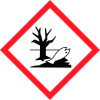
Note: Ingredients listed on restricted chemical lists
EC/CAS
403-640-2/107534-96-3
Name of the chemical
1-(4-Chlorphenyl)-4,4-dimethyl-3-(1,2,4-triazol-1-ylmethyl)pentan-3-ol (2015/1221)
Concentration
25.9%
General Information
Revision date
2018-04-27
Product name
Hail
Icons in SDS


Company Information
company name
Agform Ltd.
e-mail address of the competent person responsible for the Safety Data Sheet
msds@agform.com
GHS Information
Signal word
Danger
Hazard Codes
Hazard statements (CLP)
H302, H318, H332, H335, H361d, H400, H410
Hazard statements
Code
Statements
H302
Harmful if swallowed
Section 2
SECTION 2: Hazards identification
Regulation (EC) No. 1272/2008]
CLP CLASSIFICATION
Acute Toxicity, Category 4 H302: Harmful if swallowed Acute Toxicity, Category 4 H332: Harmful if inhaled Eye Damage, Category 1 H318: Causes serious eye damage Specific Target Organ Toxicity – Single Exposure, Category 3 H335: May cause respiratory irritation Reproductive Toxicity, Category 2 H361d: Suspected of damaging the unborn child Aquatic Acute Toxicity, Category 1; H400 - Very toxic to aquatic life Aquatic Chronic Toxicity, Category 1; H410 - Very toxic to aquatic life with long lasting effects
Additional information
For abbreviations, refer to Section 16.
2.2 Label elements
Labelling according to Regulation (EC) no. 1272/2008 [CLP/GHS]
Signal word
Danger
Hazard statements
H302: Harmful if swallowed H318: Causes serious eye damage H332: Harmful if inhaled H335 May cause respiratory irritation H361d: Suspected of damaging the unborn child H400: Very toxic to aquatic life H410: Very toxic to aquatic life with long lasting effects
Precautionary statements
P280: Wear protective gloves and eye/face protection P305+351+338 IF IN EYES Rinse cautiously with water for several minutes. Remove contact lenses, if present and easy to do Continue rinsing. P310: Immediately call a POISON Centre or doctor/physician. P391: Collect Spillage P501: Dispose of contents / container to a licensed hazardous-waste disposal contractor or collection site except for empty clean containers which can be disposed of as non-hazardous waste.
2.3 Other hazards
None known



