

Note: Ingredients listed on restricted chemical lists
EC/CAS
1310-73-2
Name of the chemical
sodium hydroxide
Concentration
N/A
EC/CAS
215-185-5
Name of the chemical
Potassium or sodium hydroxide (20)
Concentration
N/A
General Information
Revision date
2017-07-08
Product name
ARKANA DEVELOPER
1.2.1 Relevant identified uses
Photographic developer solution
supplier name
Agfa-Gevaert Ltd
Manufacturer Name
Agfa Graphics NV
Emergency telephone
(Belgium) +32 3 4443333 (24h/24h
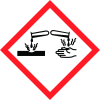
Icons in SDS
Company Information
company name
Agfa-Gevaert Ltd
e-mail address of the competent person responsible for the Safety Data Sheet
electronic.sds@agfa.com
GHS Information
Signal word
Danger
Hazard Codes
Hazard statements (CLP)
H290, H314, H318
Hazard statements
Code
Statements
H290
May be corrosive to metals
Section 2
2.1 Classification of the substance or mixture
The product has been classified according to the legislation in force.
EU Classification
Regulation (EC) No 1272/2008 as amended
Physical hazards
Corrosive to metals Category 1 H290: May be corrosive to metals.
Health hazards
Skin corrosion Category 1A H314: Causes severe skin burns and eye damage. Serious eye damage Category 1 H318: Causes serious eye damage.
Contains
sodium hydroxide Poly(oxy-1,2-ethanediyl), α-isotridecyl-ω-hydroxy-, phosphate
Signal word
Danger
Hazard statements
H314: Causes severe skin burns and eye damage. H290: May be corrosive to metals.
Prevention
P280: Wear protective gloves/protective clothing/eye protection/face protection.
Response
P301+P310 IF SWALLOWED Immediately call a POISON CENTER/doctor/… P330: Rinse mouth. P331: Do NOT induce vomiting. P303+P361+P353 IF ON SKIN (or hair) Take off immediately all contaminated clothing. Rinse skin with water [or shower]. P310: Immediately call a POISON CENTER/doctor/… P305+P351+P338 IF IN EYES Rinse cautiously with water for several minutes. Remove contact lenses, if present and easy to do. Continue rinsing. P390: Absorb spillage to prevent material damage.
2.3 Other hazards
Not fulfilling PBT (persistent/bioaccumulative/toxic) criteria Not fulfilling vPvB (very persistent/very bioaccummulative) criteria



