



Note: Ingredients listed on restricted chemical lists
EC/CAS
91-20-3
Name of the chemical
Naphthalene,3
Concentration
N/A
EC/CAS
202-049-5
Name of the chemical
Naphthalin
Concentration
N/A
General Information
Product name
Halley
Icons in SDS
Company Information
company name
AgChemAccess Limited
e-mail address of the competent person responsible for the Safety Data Sheet
enquire@agchemaccess.com
GHS Information
Signal word
Danger
Hazard Codes
Hazard statements (CLP)
H302, H304, H315, H317, H319, H332, H400, H410
Hazard statements
Code
Statements
H302
Harmful if swallowed
Section 2
2.1 Classification of the substance or mixture
Harmful Dangerous for the environment According to Regulation (EC) No 1272/2008 [CLP] Asp. Tox. 1 Acute Tox. 4 (Inhalation - vapour) Acute Tox. 4 (oral) Skin Corr./Irrit. 2 Eye Dam./Irrit. 2 Skin Sens. 1 Aquatic Acute 1 Aquatic Chronic 1 According to Directive 67/548/EEC or 1999/45/EC Harmful by inhalation Harmful if swallowed Irritating to skin May cause sensitization by skin contact Very toxic to aquatic organisms; may cause long-term adverse effects in the aquatic environment For the classifications not written out in full in this section the full text can be found in section 16. 2.2.
2.2 Label elements
According to Regulation (EC) No 1272/2008 [CLP] Globally Harmonized System, EU (GHS)
Signal word
Danger
Hazard statements
H319 Causes serious eye irritation H315 Causes skin irritation H332 Harmful if inhaled H302 Harmful if swallowed H317 May cause an allergic skin reaction H304 May be fatal if swallowed and enters airways H400 Very toxic to aquatic life H410 Very toxic to aquatic life with long lasting effects
Prevention
P280e Wear protective gloves/clothing P261d Avoid breathing vapours P264 Wash with plenty of water and soap thoroughly after handling P270 Do no eat, drink or smoke when using this product P271 Use only outdoors or in a well-ventilated area P272 Contaminated work clothing should not be allowed out of the workplace
Response
P301 + P310 IF SWALLOWED: Immediately call a POISON CENTER or doctor/physician P331 Do NOT induce vomiting P305 + P351 + P338 IF IN EYES: Rinse cautiously with water for several minutes. Remove contact lenses, if present and easy to do. Continue rinsing P302 + P352 IF ON SKIN: Wash with plenty of soap and water P333 + P313 If skin irritation or rash occurs; Get medical advice/attention P301 + P312 IF SWALLOWED: Call a POISON CENTER or doctor/physician if you feel unwell P330 Rinse mouth P304 + P340 IF INHALED: Remove victim to fresh air and keep at rest in a position comfortable for breathing P361 Remove/Take off immediately all contaminated clothing P391 Collect spillage Hazard determining component(s) for labelling: PYRACLOSTROBIN According to Directive 67/548/EEC or 1999/45/EC: Classification/labelling in accordance with UK regulations.
Hazard pictograms
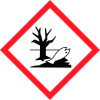
Xn Harmful N Dangerous for the environment
R-phrase(s)
R20 Harmful by inhalation R22 Harmful if swallowed R43 May cause sensitization by skin contact R50/53 Very toxic to aquatic organisms; may cause long-term adverse effects in the aquatic
S-phrase(s)
S2 Keep out of the reach of children S13 Keep away from food, drink and animal feeding stuffs S20/21 When using do not eat, drink or smoke S35 This material and its container must be disposed of in a safe way S37 Wear suitable gloves S46 If swallowed, seek medical advice immediately and show this container or label S57 Use appropriate container to avoid environmental contamination Hazard determining component(s) for labelling: PYRACLOSTROBIN
2.3 Other hazards
According to Regulation (EC) No 1272/2008 [CLP]
Other hazards
GHS) See section 12 - Results of PBT and vPvB assessment If applicable information is provided in this section on other hazards which do not result in classification but which may contribute to the overall hazards of the substance or mixture.



