

Note: Ingredients listed on restricted chemical lists
EC/CAS
1310-73-2
Name of the chemical
sodium hydroxide
Concentration
80-90
General Information
Version
1.2
Revision date
2022-06-23
Product name
Pan Brite
1.2.1 Relevant identified uses
Caustic CIP cleaner. For professional use only
Emergency telephone
1-800-424-9300
Icons in SDS


Company Information
company name
AFCO
GHS Information
Signal word
Danger
Hazard Codes
Hazard statements (CLP)
H290, H314, H318, H402
Hazard statements
Code
Statements
H290
May be corrosive to metals
Section 2
SECTION 2: Hazards identification
Classification (GHS-US) Classification of the Substance or Mixture Classification (GHS-US) Met. Corr. 1 H290 Skin Corr. 1A H314 Eye Dam. 1 H318 Aquatic Acute 3 H402
2.2 Label elements
GHS-US Labeling
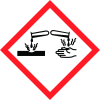
Hazard pictograms
GHS05
Signal word
Danger
Hazard statements
H290 – May be corrosive to metals H314 – Causes severe skin burns and eye damage H318 – Causes serious eye damage H402 – Harmful to aquatic life
Precautionary statements
P234 – Keep only in original container. P260 – Do not breathe dust if inhalable particles of dust occur during use. P264 – Wash hands, forearms, and other exposed areas thoroughly after handling. P273 – Avoid release to the environment. P280 – Wear protective gloves, protective clothing, eye protection, face protection. P301+P330+P331 – IF SWALLOWED: rinse mouth. Do NOT induce vomiting. P303+P361+P353 – IF ON SKIN (or hair): Remove/Take off immediately all contaminated clothing. Rinse skin with water/shower. P304+P340 – IF INHALED: Remove person to fresh air and keep at rest in a position comfortable for breathing. P305+P351+P338 – IF IN EYES: Rinse cautiously with water for several minutes. Remove contact lenses, if present and easy to do. Continue rinsing. P310 – Immediately call a POISON CENTER or doctor/physician. P321 – Specific treatment (see section 4). P363 – Wash contaminated clothing before reuse. P390 – Absorb spillage to prevent material damage. P405 – Store locked up. P406 – Store in corrosive resistant container with a resistant inner liner. P501 – Dispose of contents/container according to local, regional, national, territorial, provincial, and international regulations.
Other hazards which do not result in classification
N/A
2.3 Other hazards
Exposure may aggravate those with pre-existing eye, skin, or respiratory conditions. When heated to decomposition, emits toxic fumes. Contact with metals may evolve flammable hydrogen gas
Ingredient(s) with unknown acute toxicity
Not available.
2.1 Classification of the substance or mixture
Classification (GHS-US) Met. Corr. 1 H290 Skin Corr. 1A H314 Eye Dam. 1 H318 Aquatic Acute 3 H402



