




Note: Ingredients listed on restricted chemical lists
EC/CAS
270-705-8/68476-86-8
Name of the chemical
Petroleum gases, liquefied, sweetened
Concentration
15-40%
EC/CAS
204-658-1/123-86-4
Name of the chemical
acetic acid, butyl ester
Concentration
10-30%
EC/CAS
265-192-2/64742-89-8
Name of the chemical
Solvent naphtha (petroleum), light aliph
Concentration
0.5- 1.5%
General Information
Version
03
Revision date
2018-12-04
Product name
Engine Enamel
1.2.1 Relevant identified uses
Use on cast metal engine blocks, transmissions, pipes, radiators, farm and marine equipment, and other automotive and industrial equipment
1.2.2. Uses advised against
Do not apply if air and surface temperatures are below 40°F (4°C), or if rain is imminent within 6 hours. Do not apply to the exhaust system, use Aervoe Hi-Temp paints
Emergency telephone
1-800-424-9300
Icons in SDS


Company Information
company name
Aervoe industries Incorporated
e-mail address of the competent person responsible for the Safety Data Sheet
mailbox@aervoe.com
GHS Information
Signal word
Danger
Hazard Codes
Hazard statements (CLP)
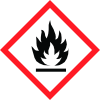
H220, H222, H225, H226, H229, H319, H336, H340, H350
Hazard statements
Code
Statements
H220
Extremely flammable gas
Section 2
SECTION 2: Hazards identification
Classifications
Physical hazards
Aerosol - Category 1 Flam. Liq. 2 Flam. Liq.3 Flam. Gas 1 Press. Gas
Health hazards
STOT SE 3 Eye Irrit. 2 Carc. 1B Muta. 1B
Environmental hazards
N/AV
Signal word
Danger
Hazard statements
H220 – Extremely flammable gas. H222 – Extremely flammable aerosol. H225 – Highly flammable liquid and vapour H226 – Flammable liquid and vapour. H229 – Pressurized container: may burst if heated H319 – Causes serious eye irritation. H336 – May cause drowsiness or dizziness H340 – May cause genetic defects H350 – May cause cancer
Precautionary statements
P101 - If medical advice is needed, have product container or label at hand P102 - Keep out of reach of children P103 - Read label before use P210 - Keep away from heat/sparks/open flames/hot surfaces - no smoking P211 - Do not spray on an open flame or other ignition source P251 - Pressurized container: Do not pierce or burn, even after use P261 - Avoid breathing dust/fume/gas/mist/vapours/spray P262 - Do not get in eyes, on skin, or on clothing P264 - Wash … thoroughly after handling P280 - Wear protective gloves/eye protection/face protection P303+P361+P353 - If on skin or hair, remove/takeoff immediately all contaminated clothing. Rinse skin with water/shower. P410+P412 - Protect from sunlight. Do not expose to temperatures exceeding 50ºC/122ºF P501 - Dispose of contents/container in accordance with local/regional/national/international regulation
2.1 Classification of the substance or mixture
Physical Hazards: Aerosol - Category 1 Flam. Liq. 2 Flam. Liq.3 Flam. Gas 1 Press. Gas Health Hazards: STOT SE 3 Eye Irrit. 2 Carc. 1B Muta. 1B Environmental Hazards: N/AV



