



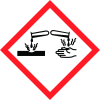
General Information
Revision date
2023-05-25
Product name
Mitoquinone
Substance name
Contains 10-(4,5-dimethoxy-2-methyl-3,6-dioxocyclohexa-1,4-dien-1-yl)decyl-triphenylphosphanium
CAS No.
444890-41-9
1.2.1 Relevant identified uses
For research use only. Not for use in diagnostic procedures
Manufacturer Name
Abcam plc
Emergency telephone
+44 1273 289451
Icons in SDS


Company Information
company name
Abcam plc
e-mail address of the competent person responsible for the Safety Data Sheet
technical@abcam.com, sds@abcam.com
GHS Information
Signal word
Danger
Hazard Codes
Hazard statements (CLP)
H315, H317, H318, H334, H335, H341, H361, H370, H413
Hazard statements
Code
Statements
H315
Causes skin irritation
Section 2
SECTION 2: Hazards identification
Classification of the substance or mixture GB CLP (SI 2020/1567 as amended) Skin corrosion/irritation Category 2 - (H315) Serious eye damage/eye irritation Category 1 - (H318) Respiratory sensitisation Category 1 - (H334) Skin sensitisation Category 1 - (H317) Germ cell mutagenicity Category 2 - (H341) Reproductive toxicity Category 2 - (H361) Specific target organ toxicity — single exposure Category 1 Category 3 - (H370, H335) Chronic aquatic toxicity Category 4 - (H413)
Contains
10-(4,5-dimethoxy-2-methyl-3,6-dioxocyclohexa-1,4-dien-1-yl)decyl-triphenylphosphanium
Signal word
Danger
Hazard statements
H315 - Causes skin irritation H317 - May cause an allergic skin reaction H318 - Causes serious eye damage H334 - May cause allergy or asthma symptoms or breathing difficulties if inhaled H335 - May cause respiratory irritation H341 - Suspected of causing genetic defects H361 - Suspected of damaging fertility or the unborn child H370 - Causes damage to organs H413 - May cause long lasting harmful effects to aquatic life
Precautionary statements
P280 - Wear protective gloves/protective clothing and eye/face protection P260 - Do not breathe dust/fume/gas/mist/vapours/spray P264 - Wash face, hands and any exposed skin thoroughly after handling P304 + P340 - IF INHALED: Remove person to fresh air and keep comfortable for breathing P305 + P351 + P338 - IF IN EYES: Rinse cautiously with water for several minutes. Remove contact lenses, if present and easy to do. Continue rinsing P310 - Immediately call a POISON CENTER or doctor
2.3 Other hazards
Caution - substance not yet tested completely.
2.1 Classification of the substance or mixture
GB CLP (SI 2020/1567 as amended) Skin corrosion/irritation Category 2 - (H315) Serious eye damage/eye irritation Category 1 - (H318) Respiratory sensitisation Category 1 - (H334) Skin sensitisation Category 1 - (H317) Germ cell mutagenicity Category 2 - (H341) Reproductive toxicity Category 2 - (H361) Specific target organ toxicity — single exposure Category 1 Category 3 - (H370, H335) Chronic aquatic toxicity Category 4 - (H413)



